
Yui Otaku 結 オタク
Finding my people

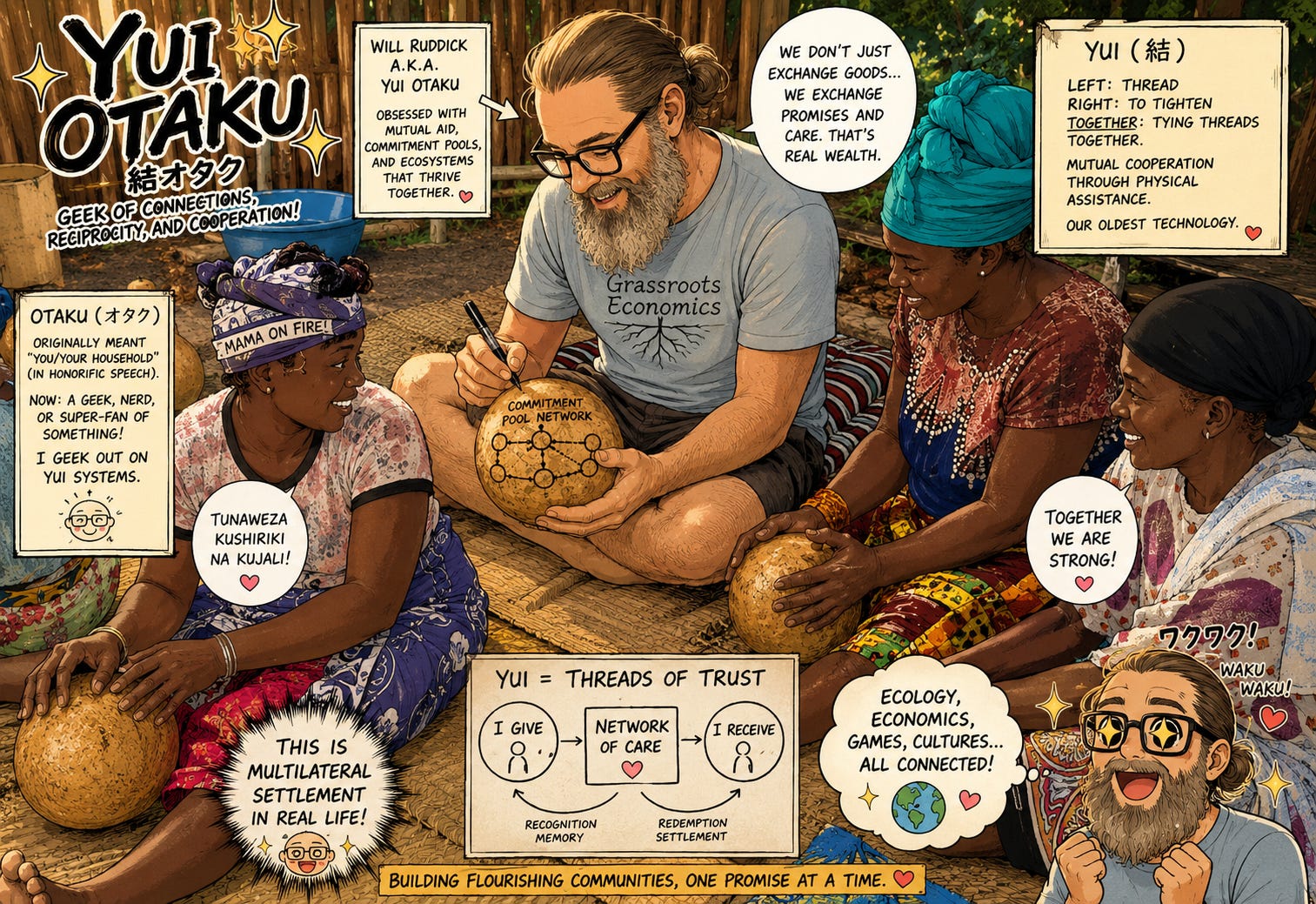
For most of my life I thought I was just a strange kind of economist. Not the kind who gets excited about stock prices, GDP reports, or central bank announcements.
The kind who gets excited by irrigation systems. The kind who sees a village repairing a footpath together and thinks, “Whoa dude, that’s awesome beautiful. ….I wonder how they coordinate contributions over generations, remember obligations, and settle commitments.”
I hadn’t found a support group for my condition …
For years I assumed everyone secretly wondered about these things and just didn’t talk about it. Surely everyone wanted to spend their evenings reading about rotating labor associations, community currencies, sacred forests, mutual aid societies, gift economies, burial associations, fungal networks, and cooperative game theory?
Then I stumbled across two Japanese words that helped me understand myself and find my people.
Yui (結)
The character itself is cool. The left side means “thread.” The right side means something like “to bind firmly” or “to tighten.”
Together they express the image of threads being tied together into something stronger than any individual strand (very grassroots). But Yui is not merely a word about knots. Traditionally it referred to mutual cooperation through physical assistance. Villagers helping villagers. Families helping families. People coming together to build, plant, harvest, repair, celebrate, mourn, and survive.
Yui is cooperation made tangible. It is relationship with calluses on its hands. It is trust carrying a shovel.
Otaku (オタク).
The story of this word is fun and strange.
Originally otaku referred to another person’s home or household. As I understand, it was a polite and somewhat distant way of saying “you.” Over time it evolved into slang describing people who became intensely devoted to a particular subject.
Train otaku. Computer otaku. History otaku. Anime otaku.
People who do not merely enjoy a subject. People who disappear into it. People who learn every detail, compare notes, collect examples, develop theories, debate obscure distinctions, and become joyfully obsessed.
The term has sometimes been used negatively. It can imply someone disconnected from reality. But every otaku knows a secret …. Reality is often far more interesting once you start paying close attention.
So it hit me that ….
I was a Yui Otaku (結 オタク). A geek of cooperation. A nerd of reciprocity. A student of the strange and beautiful ways living systems learn to coordinate.
I see Yui everywhere. Not just in villages. Not just in human societies.
Everywhere.
I found it underground in forests. In capital markets and banks. In boardrooms and rural farmers.
In conversations in settlement systems. In distributed memory. Ecological experiments in cooperation. In distributed ledger systems. In ancient forms of resource coordination. In the three sisters and myriad plant guilds.
The more I looked, the more Yui seemed less like a cultural practice and more like a universal pattern. Coral reefs. Bee colonies. Watersheds. Open source software projects. Community kitchens. Neighborhood childcare circles. Volunteer fire brigades. Rotating savings groups. Mutual aid networks. Traditional commons. Scientific collaborations. Cooperatives. Commitment Pools, Even multiplayer games. Especially games.
A good game is often a little Yui. A group of people accepts a shared set of commitments and discovers how cooperation creates possibilities unavailable to isolated individuals.
The most memorable games are rarely about domination. They are about coordination. About timing. About trust. About discovering how a group can accomplish something together that none of its members could accomplish alone.
This realization changed the way I think about economics. Most economic stories begin with scarcity. Most Yui stories begin with relationship.
Most economic models begin with individuals. Most Yui systems begin with interdependence.
Most economic discussions ask how resources move. Yui asks how commitments move. How trust moves. How care moves. How memory moves. How communities learn to coordinate themselves.
This is where being a Yui Otaku becomes super fun. Because once you start studying Yui, there is no end to it. You can geek out about rotational labor systems in Kenya.
Then compare them with Japanese Yui traditions. Then discover Andean Minga practices. Then find mutual aid traditions in West Africa. Then burial societies.
Then irrigation commons. Then cooperative governance. Then ecosystem succession.
Then network theory. Then commitment pooling protocols.
Then multilateral settlement and velocity of settlement.
Then collective intelligence. Then social memory. Then promise theory.
Then fungi again.
You begin to realize that life has spent so very long in an enormous experiment:
How do autonomous beings learn to thrive together?
Not through domination. Not through perfect planning. Not through endless competition.
(but despite all that … )
Through relationship. Through reciprocity. Through mutual support. Through symbiosis.
Through Yui.
And perhaps the most wonderful part is discovering that I am not alone. For years I thought I was wandering through a niche corner of economics. Instead I found a tribe.
Yui Otaku are everywhere. We’re not just economists….
Some of us are farmers. Some are coders. Some are ecologists. Some are anthropologists. Some are game designers. Some are cooperative organizers. Some are systems theorists. Some are village elders.
Some are kids inventing new ways to play together.
We might not all even know the word Yui.
But we recognize the feeling. There is an intuitive kinaesthetic sense of it. That moment when you witness a group of people helping one another flourish and think:
“That is fascinating.” “How does that work?” “Can we learn from it?” “Can we grow more of it?”
If that sounds familiar, you may be a Yui Otaku too.
And if you are, welcome.
Pull up a chair or cushion.
Share about the most beautiful cooperation system you’ve ever seen.
Was it a village? A forest? A game? A community commons? A neighborhood garden? A grandmother who somehow coordinated an entire community with nothing but relationships and a notebook?
Let’s compare notes. Let’s swap stories. Let’s geek out together.
Let’s let go of the industrialization of the commons and mutual aid. Let’s let go of having to earn money by selling togetherness.
It is worth it … because…
Yui may be one of humanity’s oldest discoveries.
And it may also be one of our most important frontiers.
p.s. There is a reasons I didn't mention Fureai Kippu in the article, despite having a lot of respect for it.
After three trips to Japan, I found that many of the community currencies and complementary currency experiments I had been reading about no longer existed. Not just Fureai Kippu-related projects, but many of the systems influenced by Bernard Lietaer's work as well.
What struck me was a categorization problem that I now see almost everywhere.
People often treat coordination as a subset of money.
I think it is the opposite.
Money, currencies, mutual credit, voucher, community currencies, trade credits, loyalty points, and all kinds of fungible units are actually a small subset of a MUCH larger family of coordination systems.
When we become fixated on the token, the currency, or the unit being exchanged, we can end up missing the deeper pattern that made the system work in the first place.
To me, Yui points toward that larger pattern.
Yui is not a currency.
It is not even necessarily an accounting system.
It is a way of tying people, capacities, responsibilities, and commitments together.
That is one reason I became increasingly interested in the phrase **commitment pooling**. It feels closer to the underlying phenomenon.
Currencies can fit inside commitment pools as one form of commitment.
But commitment pooling does not require currencies.
A village work party is commitment pooling.
A fungal network is commitment pooling.
A cooperative harvest is commitment pooling.
A community kitchen is commitment pooling.
A family caring for an elder is commitment pooling.
The reason I gradually shifted away from focusing primarily on community currencies is that I watched so many of them struggle or disappear. Again and again they required extraordinary maintenance, subsidies, institutional support, or the gravitational pull of a national currency to keep functioning.
Meanwhile, humans have been pooling commitments successfully for thousands of years.
Long before money.
Long before accounting.
Long before economics became a discipline.
So while Fureai Kippu is fascinating, I increasingly see it as one particular expression of a much older and much larger pattern.
Yui, at least as I am using it, points me toward the study of cooperation itself rather than toward any specific monetary implementation.
And honestly, that's where the really fun rabbit hole begins.
*bow* - in recognition