
Welcome to The Guild
A new commitment to the readers and contributors carrying this work

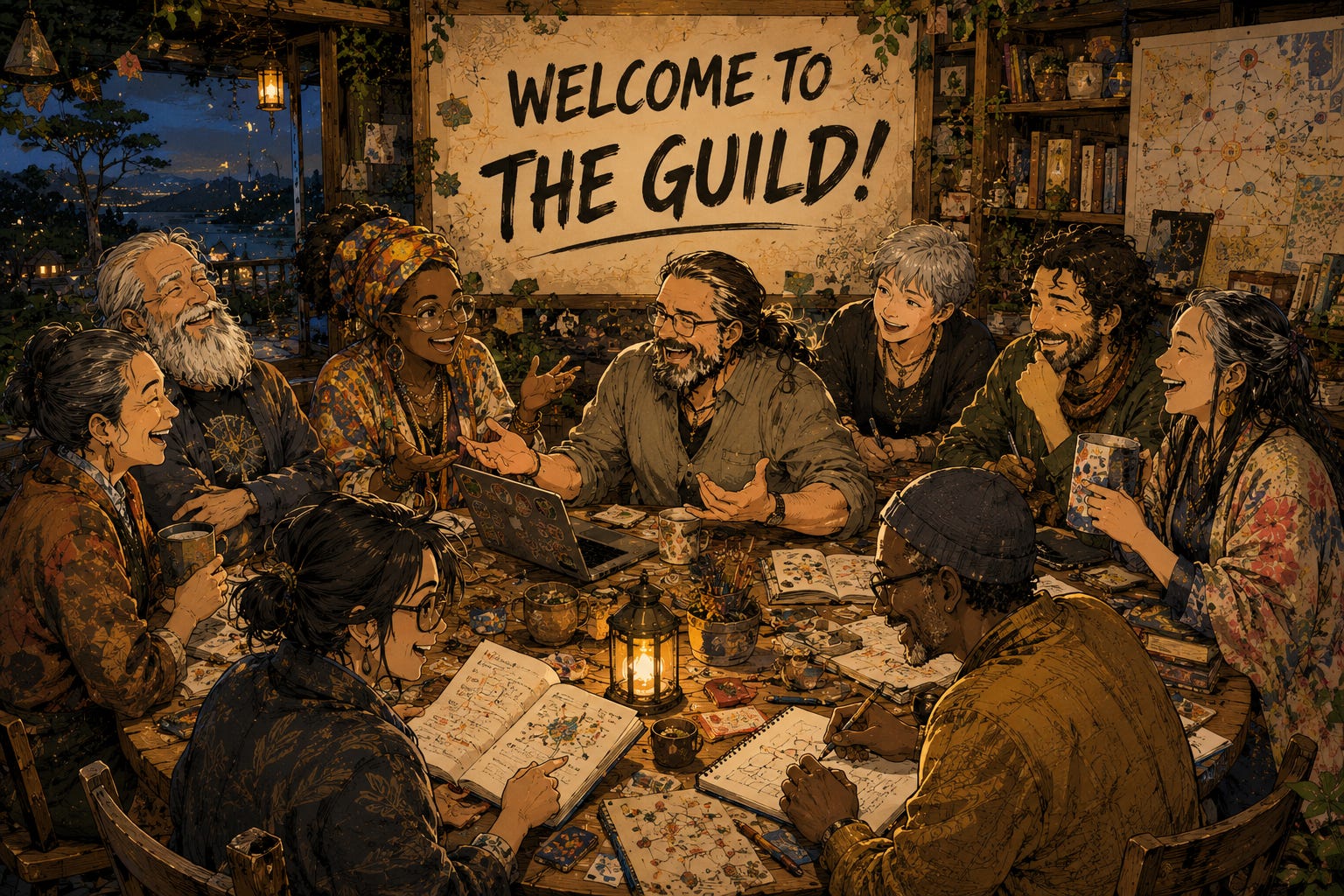
Today I am opening a new layer of this publication.
For the first time, I have published a substantial essay specifically for paid subscribers:
I Could Feel the Shape Before I Could See It
A private note to The Guild on the making of Commitment Pooling and Moral Life
The essay includes my complete (never published) academic paper, Commitment Pooling and Moral Life: From Proto-Moral Coordination to Moral Technology.
The paper has not yet been published elsewhere and may never be. I am sharing it first inside a smaller circle that has helped make this work possible.
I am calling that circle The Guild.
Why a Guild?
A few readers became paid subscribers while nearly everything I published remained freely available. There was no private archive, no quarterly gathering, and no clearly defined subscriber space.
Those subscriptions felt like acts of trust.
Each one said, in effect:
I see something here. Please keep going.
I noticed every one.
Some arrived while I was tired, uncertain, or struggling with work that had stopped making sense. That support created time, courage, and a sense that the questions mattered beyond my own desk.
In Subscription as Commitment, I described a subscription as a future-oriented relation. A subscriber offers support now because of work that has been received and work that may still come. I become answerable for how I tend that trust.
The Guild is my attempt to make my side of that commitment more concrete.
I am committing to:
host one group Zoom session for Guild members each quarter;
publish private essays, research notes, working concepts, diagrams, reading trails, and field reflections;
share substantial papers, drafts, and supplementary materials when they are ready;
show more of the uncertainty, revision, and criticism behind finished work;
bring serious questions and disagreements from Guild discussions into my writing and research agenda.
I chose the word guild because it suggests a group gathered around a craft. The craft here includes field practice, institutional design, economic experimentation, moral inquiry, software, writing, criticism, and learning how commitments can become more visible and accountable.
The Guild is meant to be a workshop around the work.
I am inviting intelligent resistance
The Guild is not an agreement club. I want careful resistance.
Where does the commitment lens reveal something that another framework misses?
Where does it impose commitment language on a relationship that should be understood differently?
Which forms of care, coercion, identity, belonging, or historical power remain outside the map?
What evidence would show that commitment pooling adds little in a particular case?
And, more personally:
Where have commitments shaped a relationship in your own life without appearing in a formal account?
The framework will improve through comparison, counterexamples, participant correction, practical use, implementation, and formal testing. The Guild sessions will create room to examine where it helps and where it fails.
I will announce the first quarterly session soon.
Honoring contributors as well as subscribers
Financial support is one way of carrying this work. It is not the only way this work has been carried.
Research, translation, fieldwork, code, testing, teaching, community practice, careful criticism, introductions, and patient collaboration have all made parts of this inquiry possible.
Some longstanding contributors may be unable to pay for a subscription. If that describes your situation, and a significant contribution has helped carry this body of work, please message me privately. Tell me what the contribution was and why access to The Guild matters.
I will consider a limited number of manually granted memberships according to available capacity. I cannot promise a place for every request, and I want to be transparent about that limit.
This is one way I can recognize commitments that have already moved toward the work in forms other than money.
What remains free
I will continue publishing public essays, selected field reflections, announcements, and introductions to major research.
I want the core ideas of commitment pooling to circulate beyond the paid space. Free readers continue to matter. Reading, sharing, testing an idea, carrying it into practice, or offering a careful disagreement can all help the work travel and mature.
The Guild will hold the complete archive, full research papers, private workshop essays, working materials, group sessions, and the closer discussion around emerging work. Comments and older archive access will be reserved for Guild members.
This boundary gives me a more sustainable way to keep substantial public work moving while honoring the readers who directly support the time behind it.
To those who supported the work before The Guild existed
Thank you.
You subscribed before I had published paid content or made a clear promise about what paid membership would become.
I have felt responsible for that trust.
The Guild exists partly because of the commitment you made first. The paper and private essay are the beginning of my return.
The workshop is open
Members of The Guild can now read:
I Could Feel the Shape Before I Could See It
A private note to The Guild on the making of Commitment Pooling and Moral Life
For free subscribers, thank you for continuing to read, share, question, and carry these ideas into other places.
For those choosing to become paid members, welcome to The Guild.
I am inviting you into the workshop.
Nadim asks: " Is the guild governed/managed traditionally?
Guilds, traditionally are centralized.
Structure: Rigidly hierarchical (Master, Journeyman, Apprentice).
From my side, I see you clearly as one of my very advanced masters 🙇🏻♂️🙏🥰
""
I think “The Guild” fits precisely because I am neither trying to run a conventional hierarchy nor pretending that this space begins without an authored structure.
I have been a Dungeon Master for much of my life, as well as a player. A good Dungeon Master holds a cosmology. There is a world with histories, constraints, powers, hidden relationships, and consequences. I invite players into that world to explore it, test it, find adventure within it, and sometimes change the cosmology itself through what they do.
That feels close to my role here.
I am not here simply to entertain, and I am not facilitating a sociocratic circle in which every claim must wait for consensus. I have spent a long time developing this body of work, and I am taking responsibility for its direction, standards, and coherence. In that sense, “Guild Master” feels more accurate than “host” or “facilitator.”
At the same time, I do not regard the cosmology as untouchable.
The recent paper on moral life makes that distinction especially important. It does not offer a final metaphysical account of morality. I am not claiming access to a separate moral realm, a supernatural source of value, or a uniquely human moral essence. I am holding a provisional cosmology of observable relationships: commitments, reliance, attribution, limits, explanation, repair, and release.
The cosmology gives us a world in which inquiry can occur. Moral life emerges through what participants do within that world, how their actions affect others, what becomes recognizable, what can be contested, and what evidence causes the map itself to change.
So I may hold the map, but I do not claim to be the territory.
Guild members are invited to enter the work seriously, experience its possibilities, find its weaknesses, and alter it through evidence, practice, criticism, and discovery. That will not be easy. Easy adventures are usually the least interesting ones I know.
Should a council eventually become necessary, I imagine it would emerge through demonstrated contribution, judgment, trust, and a long shared adventure. I would not create one merely to simulate participation or distribute titles.
And I remain very willing to sit at the tables of other Dungeon Masters. I want to learn their cosmologies, inhabit them honestly, and, where the adventure leads, do my best to change them from within.
So yes, The Guild has a Guild Master. But the authority involved is stewardship of an inquiry, rather than final authority over moral truth.
The cosmology structures the adventure. Moral life appears in how we participate in it, affect each other, answer for what we do, and revise the world when the evidence demands it.