
The Abundance Between Our Hands
Husking maize, pooling commitments, and creating a home for our daughter in Kiriba, Kenya

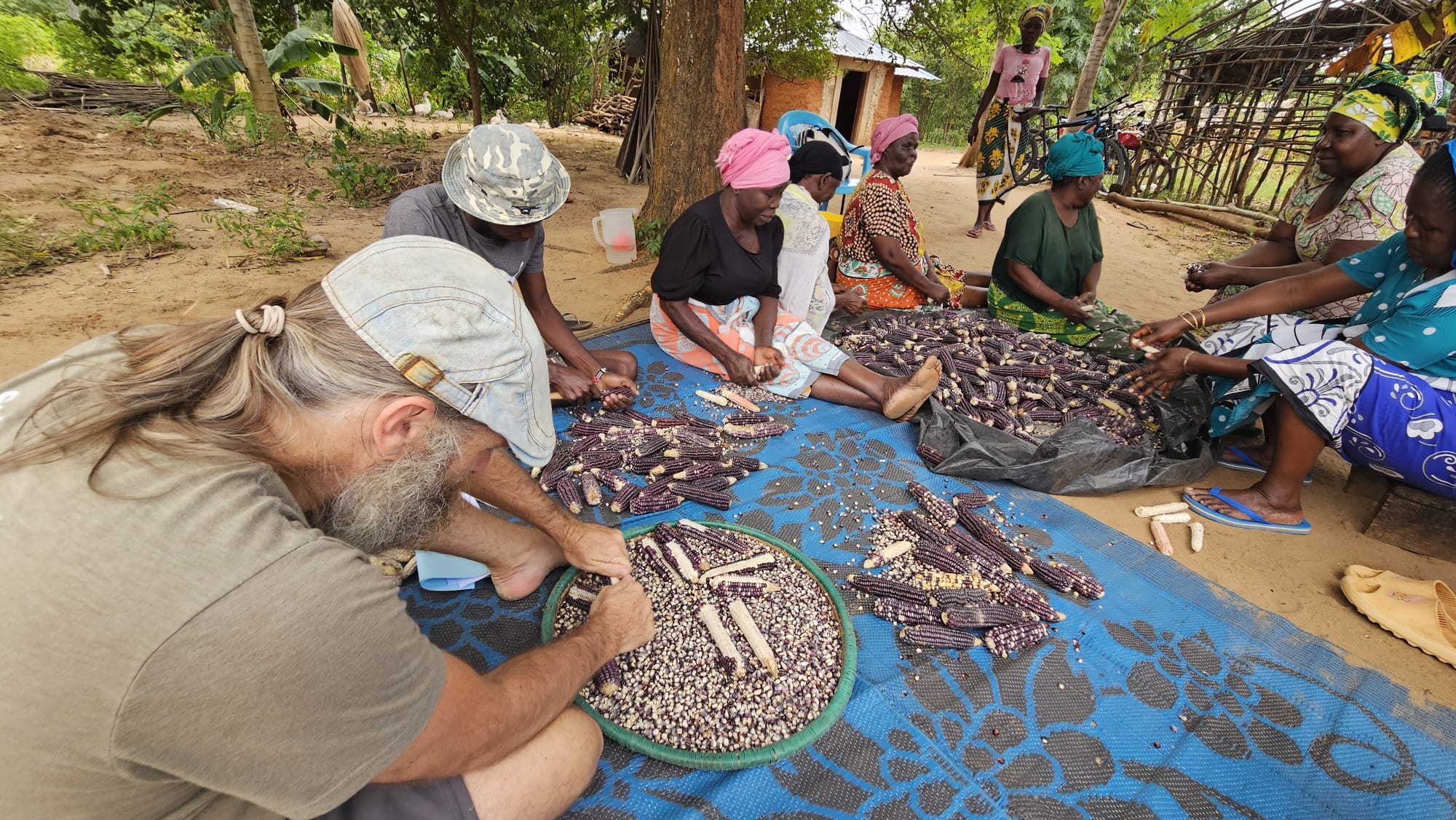
The maize cob catches for a moment in its dry husk, then comes free.
I place it beside the others and reach for another.
I am sitting outside the home of one of the women in our community in Kiriba, on the coast of Kenya. Around me, hands keep moving. Leaves pull away with a soft crackle. Cobs knock against the growing pile. Dust gathers on our fingers.
The women (the village mamas) talk as they work.
Their conversation moves through children, health, marriages, harvests, memories, and the ordinary news that holds a village together. One voice rises and another answers. Laughter moves around the circle. A quieter story draws everyone closer.
We are preparing maize (kupukusa mahindi).
We are also making time for one another.
With each cob, the pile grows. So does my sense that the work is carrying far more than a harvest.
What Gathers Around a Need
There are five groups of neighbors around us, each with about fifteen member households. Together, they reach across most of the community.
Every week, five to ten collective activities take place. People gather at one household or farm to help with work that would be difficult to complete alone.
They fence vegetable gardens against goats. They plant trees and save seeds. They dig water catchments that slow rain on the hillsides and reduce erosion. They prepare farms, process harvests, repair homes, care for children, and share the labor of whatever needs attention that week.
The groups also save money together and lend it to one another. These funds help with health care, school costs, farming, emergencies, and the many needs that arrive before cash is available.
Over time, the savings groups have also become something like local marketplaces.
A member can put forward a commitment to provide something they have the capacity to offer: vegetables, maize, transport, repairs, tailoring, building work, care, or another good or service. The group can accept that commitment into the pool, where it can support borrowing.
Someone may receive a good or service now and return value later, in money or in kind. A buyer from outside the community can also purchase from the pool, bringing outside income into a locally organized network of work and exchange.
This practice echoes Mweria, the rotational labor tradition I have encountered here. Neighbors gather around the needs of one household, then the cycle turns toward another. Labor, tools, food, skills, hospitality, and future availability move through relationships over time.
A contribution today becomes part of the remembered ground for support tomorrow.
Each pool also has limits. Members consider how much can be offered, how responsibilities are shared, what counts as completion, and how a commitment changes when illness, care work, or unexpected circumstances affect someone’s capacity.
These limits give the abundance its shape. They protect the people whose lives and labor sustain it.
Companion field report: The activity records, ecological work, community reports, and three years of measurable progress

A Place Taking Root
Over the last three years, Aude and I have been making a home in Kiriba while helping Mnyumbuni grow as a community center, demonstration farm, and gathering place.
People borrow tools there. We are making beehives for households across the community. Neighbors meet to learn about gardening, seed saving, soil restoration, water harvesting, beekeeping, and commitment pooling.
Children play near the work. People cook, teach, repair, build, exchange ideas, and spend time together.
Around us, the results are becoming visible. Gardens are protected. Young trees are taking root. Water is entering the soil. Seeds are moving between households. Skills learned in one place appear later in another.
Mnyumbuni is becoming a meeting point between ecological restoration, community economics, education, culture, and everyday life.
The community existed long before our projects or language for describing them. Families here have known one another across generations. Many people grew up knowing each other’s parents and grandparents. Their relationships already carry histories of work, kinship, celebration, disagreement, loss, and mutual support.
I arrive much later, as a foreigner carrying my own assumptions. Over time, I am welcomed into the community, and Kenya becomes the country of my citizenship as well as my home.
That welcome takes form through participation: showing up, listening, learning, contributing, receiving help, being corrected, and returning again.
Finding a Partner in the Same Direction
I enter this life with Aude, my wife, my partner, mother to our daughter Noème.
We come from different histories and often notice different dimensions of the same moment. I may see commitments, exchanges, and economic structures. Aude senses the quality of a place: whether people feel welcome, whether relationships have room to deepen, and whether the land is being cared for.
Our perspectives meet in a shared purpose.
We want care to take form in everyday life … in how food is grown, how people learn, how responsibilities are shared, how a home opens toward its neighbors, and how damaged land is restored.
Our ethics become visible through repetition: planting, listening, hosting, returning tools, keeping commitments, and changing plans when someone’s capacity changes.
That shared direction gives Noème’s future coherence. The values she hears in our words will also surround her in the life we are creating: in the food growing in the shamba, the trees outside her home, the people gathering at Mnyumbuni, and the ways neighbors respond to one another.
Over the last three years, Aude has been nesting in this wider sense.
She plants trees whose shade Noème may sit beneath years from now. She builds relationships with women who may teach our daughter words, songs, gestures, and ways of paying attention. She helps shape Mnyumbuni as a meeting place for children, elders, farmers, craftspeople, neighbors, and visitors.
A home extends through the forest, the mangrove creek, the village paths, the shamba, the tree houses, and the relationships that allow a child to feel held within a place.
Real Life Is the School
Teaching and education have become a central axis of our life together.
For Aude, real life is the school.
The forest teaches through roots, insects, shade, decay, and changing light. The shamba teaches through seed, soil, rain, patience, and harvest. The mangrove creek teaches through tides and the meeting of salt and fresh water.
The kitchen, community center, farms, tree houses, and paths between homes all carry lessons.
Relationships teach most deeply.
A child watches how adults greet one another, how they divide work, and how they respond when someone is tired. She sees an elder being heard. She watches a borrowed tool return because another household may need it. She sees a plan change when illness or care responsibilities alter what someone can offer.
This is the sensory field Aude wants to preserve around Noème: the sights, textures, rhythms, voices, and consequences through which a child learns to sense what a situation asks of her.
The soil deepens in color after rain. Mulch keeps a garden bed cool beneath the sun. A seedling bends under the pressure of a hand. A water container grows heavy on the path home. Laughter around a work circle softens when someone begins speaking about a difficulty.
Many hands find a rhythm. A pause makes room for another voice.
From these encounters, inner intelligence begins to grow.
By inner intelligence, we mean practical and relational judgment: the ability to notice, feel, and respond with care. It develops through contact with real situations … knowing when to speak, when to listen, when to offer help, when to follow someone with greater knowledge, and when to respect the limits of one’s own capacity.
A beetle crosses the path. A seed breaks through the soil. A neighbor sings while working. Another child offers a word in a different language.
Something in the world reaches her, and learning begins in the response.
Our dedication is to keep that field alive: enough safety for curiosity, enough relationship for trust, and enough real participation for learning to matter.
A Child Within Several Worlds
Noème is entering a life shaped by several places.
Kenya is her main home: Kiriba, the mangrove creek, the shamba, the tree houses, the children growing beside her, and the neighbors whose voices already surround her.
France reaches her through Aude’s family, language, memories, food, and ways of gathering. Bhutan and other communities may also become part of her world as our work and relationships carry us between countries.
Each place has its own rhythm. People welcome a child differently, prepare food differently, relate to land differently, and pass knowledge through their own gestures, stories, and traditions.
Noème will meet this diversity through life itself: playing with children, hearing several languages, walking through different landscapes, and learning how to enter each community with attention.
Across these worlds, she may also recognize a shared pattern.
Someone prepares a meal. Someone carries a tired child. Neighbors gather around work, illness, celebration, birth, harvest, or loss. People tend the places that sustain them and make room for one another.
Care takes many forms. Togetherness speaks through many languages.
This gives her a gentle coherence: a way to feel at home in difference and to notice how each community creates belonging.
Wherever she goes, she can carry one simple question: How do people here care for one another and for the place that holds them?
The Wealth Inside the Work
The women continue talking as our hands move through the maize.
Their stories remain theirs. What I carry is the experience of sitting close enough, and long enough, for those stories to be shared.
The maize gives us a reason to gather. The work creates the time.
Concerns become visible before they become crises. Someone notices fatigue, grief, humor, tension, or hope. A person’s life becomes present to others in a way that no financial account could fully record.
The gathering produces maize ready for storage and eating.
It also produces familiarity, memory, and the knowledge that someone has been heard.
Now Aude and I are returning from the hospital with Noème. She is beginning to meet the other babies and children of the village. They are small now, growing beside one another at the beginning of their own histories.
I imagine her learning that many people may arrive when a task at one household becomes too large. Tools can move between families. Seeds can be shared. A health expense can be carried by a group. Work can become a reason to sit together and listen.
She will enter a living community … one that plants trees and makes beehives, saves money and saves seeds, builds markets from commitments, and gathers around the needs of its members.
The deepest abundance I encounter here is the presence of many possible responses to a need.
It is a garden protected by many hands.
It is water held on a hillside because neighbors dig together.
It is a school cost or medical expense shared across a group.
It is a commitment made carefully because another person may rely on it.
It is a partner whose values meet mine through daily action.
It is a child learning that land, education, relationships, and work belong within one living field.
I pull another cob free and place it on the pile.
Hands continue moving. Voices continue around me. The afternoon light passes through the trees.
We are bringing our daughter home into this field of care.
The cobs gather between our hands.
The future gathers with them.
And this feels like wealth.