
Tending the Social Soil
Journeys through experience, commitment, and moral life

I begin at home which is also the Grassroots Economics office in Kiriba village, with what I can see.
There are homes, paths, gardens, goats, tools, children, elders, and workers moving between households. Women carry water. People leave for paid work and return with Kenyan shillings. Groups gather to farm, cook, repair, talk, drink tea, care for children, and complete work that would overwhelm one household acting alone.
The place feels intensely alive to me. Money moves through it, along with food, labor, care, knowledge, reputation, obligation, and disappointment. Some of these movements remain close to home. Others stretch outward toward plantations, wealthier households, imported food, public institutions, donors, a chief’s office and international funding.
I reach for the image of a social organism. It draws my attention to circulation and interdependence. It also troubles me. Kiriba contains many bodies, histories, perspectives, and needs. The community appears through a plurality of lives rather than through one body or one voice.
I notice how much daily life depends on resources arriving from elsewhere. People travel to earn cash and return to buy flour, medicine, fuel, school requirements, and other necessities. Agricultural knowledge and land remain present, while water scarcity, fragile infrastructure, unequal access, and ecological uncertainty shape what people can produce locally.
So I begin asking what remains after money, labor, food, and obligations move through the community. Do those movements leave behind greater capacity ... or greater dependence on systems beyond local reach?
At the same time, I watch another economic possibility move through rotating labor. A household receives help preparing a field or repairing a roof, then later joins the same group at someone else’s home. People contribute strength, time, food, tools, knowledge, care, and future availability. They also carry memory. They remember who arrives, who struggles, who prepares food, who has already received support, and who may be called upon later.
The exchange remains open across time. Present work rests between percieved past and anticipated future responses.
Commitment pools grow from this same practical question. A participant can issue a voucher representing farming labor, transport, food, repairs, care, currency redemption, or another undertaking. A pool can accept that voucher, assign it a value, set a limit, hold it beside other commitments, and allow people to exchange between them.
The technical structure is relatively simple. The human question keeps opening for me.
What kind of world are we helping to create when people make, recognize, pool, exchange, fulfill, revise, repair, and end commitments together?
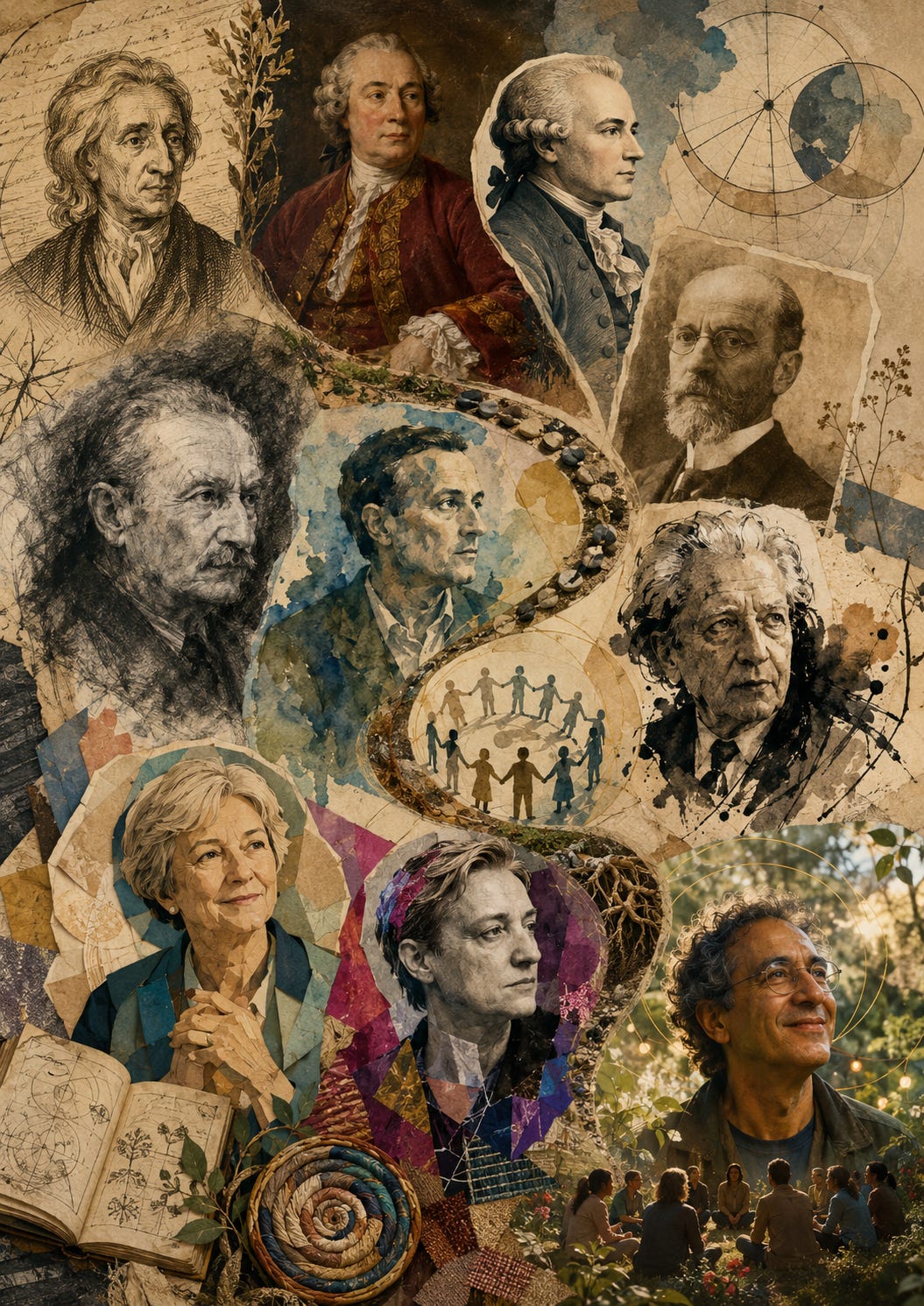
Alongside this work, I find myself tracing a particular philosophical lineage. John Locke, David Hume, Immanuel Kant, Edmund Husserl, Martin Heidegger, Maurice Merleau-Ponty, Emmanuel Levinas, Nel Noddings, Judith Butler, and Francisco Varela approach distinct questions in distinct times. I treasure their agreements and their disagreements. I place their lenses beside my own experience because I see correspondences in the questions gathering there.
This remains a selective path. Proust stands nearby in my mind around memory and time. Bergson, Arendt, Ricoeur, and many others could enter from different directions. I know how quickly I can become carried away by patterns ... how my mind can keep joining points until the whole sky becomes a constellation. I offer these correspondences with care, and I hope their illumination makes sense to you.
A note at the threshold
This is where I place the rest of the essay inside The Guild.
This publication is supported by subscribers, and this piece continues the unpublished Moral Life work I first opened to paid readers in “I Could Feel the Shape Before I Could See It”, a private note on the making of that work.
The pages below bring that inquiry back into Kiriba, the village where I live and work ... into community action, embodied capacity, commitment pooling, stewardship, external finance, and the moral weight of institutional design. I am keeping this continuation with Guild members because it asks for a slower kind of attention, and because subscriber support gives me room to follow these questions while they are still alive and changing.
