
Simple Joy
What Caring for Our Daughter Is Teaching Me About Joy, Commitment, and Social Soil

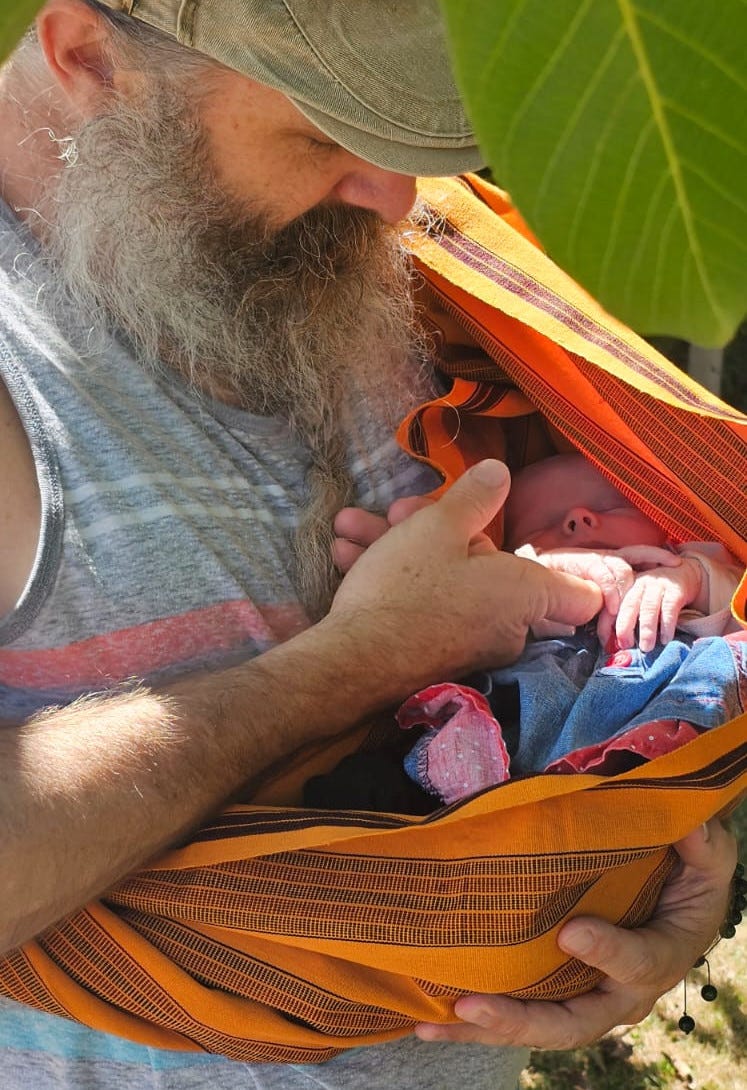
I begin with joy... simple, immediate, almost embarrassingly small.
My daughter is in my arms. She has been unsettled... then, gradually, something changes. Her breathing becomes quieter. Her face softens. Her attention rests, just briefly, on mine. Sometimes she falls asleep. Sometimes she remains awake and looks around ... taking in light, shadow, movement, and voices with an intensity I can only partly interpret.
She appears content.
I feel joy.
For a moment, this joy is solid - tangible.
The wider world can feel like shifting sand. Even in this quiet room, I can sense how many worlds surround her... the medical care that helped bring her here, the food and clothing that travelled through unknown hands, the different lives waiting for us in Kenya and Bhutan, and the unequal conditions under which families care for their children.
Already, she is changing what I thought I knew. A plan for sleep, feeding, work, or travel can dissolve in the sound of one cry. … but here, though... for a moment... I find something I can hold onto that feels true.
I have reached toward another life with care, and something in that reaching has been answered. Yes, the chemistry of oxytocin participates in this moment... instinct, duty, exhaustion, love, and personal satisfaction may all be present. The whole experience exceeds each explanation.
This joy has direction. It concerns her. It arises through the apparent easing of her distress... through the perception that she is safe enough, warm enough, held enough, to rest and grow.
My joy rises when her body softens in my arms... when the cry stops, her breathing steadies, and she seems able to rest. Joy arrives as a disclosure... a sign that my intention reached beyond myself. I attended. I adjusted. Something changed between us.
This joy offers solid, tangible evidence….
My interpretation remains partial. I can already feel the temptation to believe I know what she needs because I love her. I may keep rocking when she wants stillness... offer food when she wants contact... or hold on to one successful response after she has already changed. The discipline of caring for my daughter asks me to stay close to experience, close what appears... to revise when the evidence changes... and to keep her growing agency in view.
So I return to the experience itself. There is a child... a need, partly visible and partly unknown... my attention... an action: holding, feeding, rocking, listening, waiting, trying again... a change I interpret as contentment... and joy.
Within this sequence, a relationship begins to form.
I can sense intentionality as the directedness of experience... my perceiving, hoping, remembering, and caring are always directed toward something as it appears to me. My care is directed toward my daughter... as my child, as vulnerable, as emerging, as beautiful, as someone whose life already exceeds my own understanding.
Around this moment is a horizon... the next feeding, the next night, the first journey, the first word, the first time she pulls away from my hand. Some of these possibilities I welcome. Some I fear. Most I cannot yet see clearly. My vision is more specific... a direction consciously chosen within that wider field.
When my daughter quiets in my arms, the horizon remains open. She may wake again. I may have misunderstood what she needed. She will grow, speak, laugh, refuse me, surprise Aude and me, walk out of rooms on her own, and discover worlds that neither of us can prepare in advance.
Care takes place inside this openness... amid hope and danger, intimacy and separation, trust and misunderstanding.
Joy gives me one stable point from which to meet it all.
I feel myself moving through an unfamiliar place on shifting ground... one hand finds something firm (this joy) and holds it as a reference point... my other hand begins to feel outward.
What is beside us... what can support weight... what is fragile... where are the edges... who else is here with us?
The first handhold offers enough security to begin exploring. For me, the joy of care fulfilled becomes this handhold. It lets me approach larger questions while keeping my uncertainty alive.
From this small scene, I begin to wonder how care moves outward... from Aude and me, to our family, to the people who help us travel, work, eat, and live... and how those larger arrangements can still leave room for difference, refusal, and correction.
These questions lead outward from this relationship with my daughter, while remaining anchored in the experience of attending to a life that is not mine.
She is close to me... dependent on me and especially us (my love Aude and I)... inseparable from the shape of our days. She is also a life in her own right. Her contentment belongs to her. Her future exceeds my plans.
Even before she can speak, she exceeds what we know of her.
Aude sees her face soften and says she is settling. I watch her eyes move around the room and think she is curious. Then she cries again, and both of our interpretations fall apart. A distance remains between what she experiences and what we can perceive.
Care begins inside that distance.
We receive signs... a movement... a sound... the tightening or relaxing of her body... the direction of her gaze... the rhythm of her breathing.
I shift her against my chest... she keeps crying. Aude takes her and changes the angle slightly... still crying. We check whether she is hungry... then whether she needs changing... then perhaps she simply wants to remain close. Often care is three or four small guesses before anything softens.
Our care unfolds as attention, interpretation, response, and correction. We reach toward her with partial knowledge... she responds through signs... We revise.
Something appears to matter to another life... we become responsive to it... we act... the result returns as new evidence... then we act again.
Joy arises within this movement. It comes when the response seems to fit the need... when the distance between us is crossed sufficiently for comfort to become possible.
That is why joy feels tangible to me…. It offers a moment of contact across uncertainty.
For a brief time, our action and her condition seem to come into alignment... she rests... our attention eases... the room changes... what had been organized around urgency becomes soft, gentle and quiet.
Fulfillment is local. It belongs to this moment... this need... this response.
The future remains open, and the moment changes it slightly.
Because this response seemed to help, we may try it again. Because she settled in this position, our bodies remembers it. Because Aude and I saw what happened, we begin to share an understanding.
A small history forms. Care begins to grow memory. Etched mosaic patterns appear.
At first, that memory is bodily and practical. We learn how she prefers to be held. We begin to distinguish one cry from another... always with some uncertainty. Aude notices things I miss. We compare impressions. We slowly develop a shared language around someone who does not yet speak our language.
“She may be hungry”... “She looks tired”... “She calms when held this way”... “She has already eaten”... “Gosh she is so cute” … “Let me try.”
Each statement is provisional. Each gathers earlier experience and directs the next response.
Care becomes a shared field of attention.
Aude and I may perceive our child differently. One of us notices tiredness while the other suspects hunger. One feels confident while the other feels overwhelmed. One has more energy now. One remembers the previous feeding more clearly. The tea goes cold somewhere nearby.
Care begins to move between us.
The need before us benefits from more than one perspective... so we speak, offer interpretations, take turns, correct one another, disagree, and sometimes recognize that one of us has reached a limit.
The joy of care fulfilled is joined by another recognition...
Our care depends on capacity.
I may wish to remain endlessly available... yet tiredness changes my attention, patience, and judgment. Aude also has limits. Our daughter’s needs arrive according to rhythms of their own. Care directs us toward her well-being... and wise care also attends to the condition of each caregiver. Capacity needs renewal. Attention needs rest. Support needs circulation.
… which is what gives us coordination.
“Can you hold her while I sleep?”... “I will take this feeding”... “You prepare what we need for tomorrow”... “I need help now.”
These statements begin to shape the immediate future.
When Aude says, “I will take the next shift,” I can rest because I rely on that response.
A future action has entered the present.
I sleep because Aude has agreed to remain awake... Aude eats because I am holding the baby... one of us prepares for travel because the other gathers what our daughter will need.
When Aude says she will take the next shift, I lie down differently. I stop listening for every sound. Her commitment changes what my body can do now.
Clarity about what was offered, accepted, and relied upon can protect intimacy.
They help our love make room for clarity. They allow our invisible labor to become visible. They give us a way to say, “This is more difficult than I expected”... “I understood our agreement differently”... “I need help”... “I need this arrangement to change.”
Our care remains alive when such statements can alter the future.
Mutual care grows when these differences enter a shared understanding and each life retains its own standing.
I begin to see social soil in the life forming around her... in how Aude and I speak when we are tired, how we divide the night, which work we notice, how we ask for help, and how we return to one another after misunderstanding.
Our daughter enters this soil.
She enters the life Aude and I already have... our work, our travel, our families, our different kinds of knowledge, our unequal energy from one hour to the next, and the people we can call when we need help. She is held by our arms... and by all of these arrangements.
Soon we will carry her with us to Kenya and Bhutan. She will be held by different arms, hear different languages, sleep in unfamiliar rooms, and enter relationships that Aude and I cannot fully script for her. I am curious about what she will receive there... and about what our own habits will prevent us from seeing.
Her immediate world is so very tender... and it already reaches beyond us and beyond the room. The blanket around her was made by hands in Bhutan and given to us as a gift from a dear friend. The food that sustains Aude and me came through farms, roads, markets, and kitchens. The advice we follow comes from midwives, doctors, relatives, books, messages, and remembered family practices.
Some relations renew life... some concentrate burden... many remain outside my direct view.
The joy grows within these conditions.
So I hold it with one hand … the joy I feel... and reach outward with the other.
When I am resting with her in my arms, who prepared the food... who washed what we needed... who answered the work message... who stayed awake before me... whose exhaustion made this quiet moment possible?
Our daughter cannot yet explain her experience (at least not in this language). We interpret on her behalf while remembering that her signs exceed our account. Her present dependence intensifies our responsibility... and her emerging agency gives that responsibility a direction.
Our care supports her capacity to encounter, interpret, and act within the world increasingly for herself. That is really fun to imagine and be part of!
For me, a moral life begins in these ordinary corrections... noticing that Aude is exhausted... admitting that I misunderstood our daughter... asking again rather than assuming... changing what I do.
The joy of care fulfilled remains an anchor for me. It reveals a vast and beautiful horizon of relational possibility...
Attention can reach another life... capacity can be renewed... trust can grow... and another action becomes possible. Bit by bit.
When I hold her and she settles, something becomes possible... rest becomes possible... attention becomes possible... growth becomes possible... my own next action becomes possible.
Our care renews capacity.
In our small family, healthy social soil may sound like, “I need sleep”... “I got that wrong”... “Can we change the plan?”... “I see what you carried.” It gives need a voice, limits a place, and mistakes a path toward repair.
It gives life enough ground to continue unfolding.
Our daughter will grow beyond our arms. Her agency will expand. Her interpretations will differ from mine. The care she needs will change.
I have much to learn... yet I know the feeling from which I want to begin. One hand holds the simple joy of care fulfilled... the other reaches into the uncertain world.
From that position... anchored enough to explore... I begin to ask how we as families, communities, businesses, networks, farms, digital systems, and institutions might become better stewards of the social soil.
I sense the task as bringing forward the structure revealed in the experience...
attention that keeps watching... response that leaves room for her signals... commitments Aude and I can actually accept...
memories we can correct... limits spoken before exhaustion becomes resentment...
and repair that lets the next night begin differently.
This is the social soil we are already part of, already cultivating, and want our daughter to inherit.