
Seed the Loop
A small gift for Takaungu Watershed, and a reminder that support is supposed to return

I do not ask much from those who read these articles.
Mostly I ask you to walk with me through some strange thought. To consider a village as a body. To imagine money as a promise. To think about fungi, grandmothers, ledgers, rivers, goats, children, and sometimes the embarrassing plumbing of civilization.
Today I am asking for something simpler.
Please seed the loop for the Takaungu Watershed.
A small gift can go a long way here. Matching funds are available through the Ma Earth campaign, which means even a few dollars can help bring more support into community-led work: water harvesting, soil care, food growing, nurseries, tools, services, local support, and the stubborn miracle of neighbors showing up again.
Donate and share:
https://maearth.com/grassroots-economics/7ab7572b
Read the full Takaungu story:

That is the ask.
That is the whole thing.
You can stop here, donate, share, and go drink tea with the quiet dignity of a person who has done something useful.
But if you want to know why I am excited enough to make an infographic with arrows, hearts, tools, and the phrase “Seed the Loop” like a man who has finally accepted his inner community-economics raccoon, here is the simple version.
The loop
Pooling resources is an ancient thing.
Maybe older than money. Maybe older than mud.
A family stores food. Neighbors share labor. A group keeps tools together. A village remembers who helped build a roof, who brought seed, who was sick, who cooked, who carried water, who came to meetings when there was no payment, who showed up when showing up mattered.
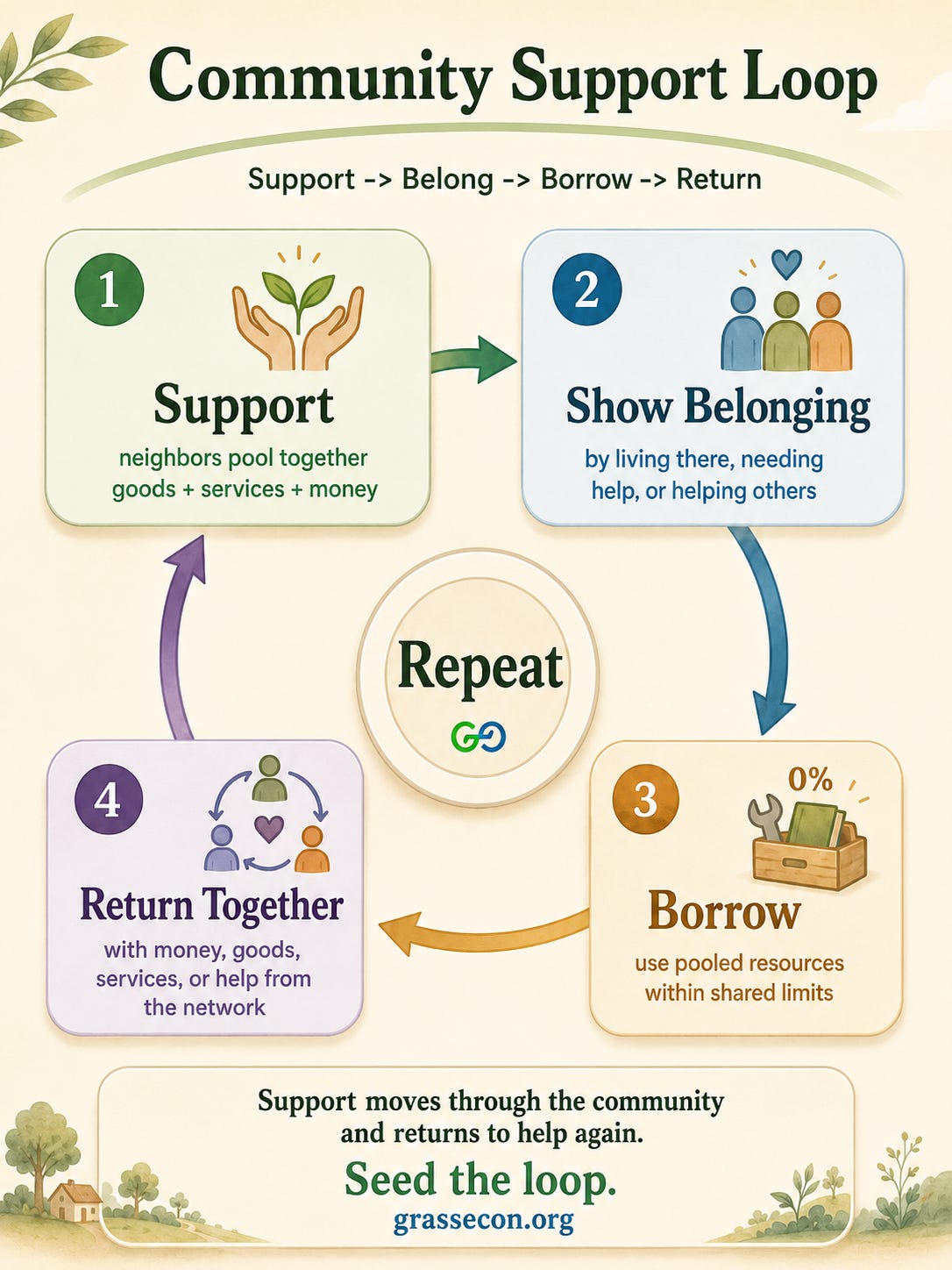
1. Something is offered.
That is a first movement. (n.b. there are many paths into the pool)
It might be money from outside. It might be food, labor, tools, seeds, time, care, knowledge, transport, or a place to gather from inside the community. It might be one person’s cash and another person’s hands. It might be small, almost laughably small.
But small things change when they enter a living loop.
2. Then comes belonging.
Belonging is not always earned by today’s work. Sometimes a person belongs because they live there. Because they are old. Because they are young. Because they are caring for children. Because they are in a hard season. Because they helped before. Because they will help later. Because the community remembers them as part of the body.
A community knows many forms of belonging.
3. Then borrowing becomes possible.
When a pool exists, someone can use what is in it, within limits the group understands. The limits matter. Without limits, support becomes chaos. With the right limits, the pool can serve this person now and still be alive for the next person.
4. Then comes return.
Return does not always mean giving back the exact same thing received.
Someone may receive money and return with food.
Someone may receive tools and return with labor.
Someone may receive help during a hard month and later repair a roof, plant a field, carry goods, cook for a gathering, teach a child, tend a nursery, or bring someone else into the circle.
The whole network can help a person return.
Return is not only a private payment between two isolated people. It can be a social path back into balance.
That is the loop:
Support.
Belong.
Borrow.
Return.
… and Repeat.
Not glamorous or complicated.
Also, somehow, the thing modern life keeps forgetting how to do.
Why this ask
I am asking you to seed this loop.
I am also asking you to look for loops near you.
Those are not opposites.
This is curation.
I am focused on what I can see and trust and touch. I know this place. I know many of the people - they are my neighbors. I have walked the paths. I have seen the water works. I have sat with the groups. I have watched the meetings, the cooking, the nurseries, the soil work, the awkwardness, the patience, the human beings trying again.
That does not make this the only worthy loop.
It makes it the one I can ask for with a straight face.
A healthy world will not be seeded from one center. It will be seeded by many people, in many places, learning to notice what is near enough to care for and clear enough to trust.
So yes, please help the Takaungu watershed community.
And also, please look around.
There may be (most definitely is) a loop near you already waiting.
What Takaungu shows
The Takaungu Watershed work in Kilifi, Kenya gives this pattern a living place to stand.
At Mnyumbuni and around the nearby community groups, neighbors have been working on water harvesting, soil building, tree nurseries, food forests, beekeeping, composting, kitchen gardens, road repair, erosion control, cooking, learning, and local governance.
This is practical work. It is also social work.
Water does not stay in the soil because a report says it should. Trees do not survive across seasons because a dashboard looked promising.
A watershed is cared for by hands, habits, tools, meetings, memory, repair, and a shared decision to return again and again.
The Takaungu watershed community work connects upland farms, paths, indigenous forest areas, community spaces, and the creek edge. The simple idea is that care upstream matters downstream. When water can soak in, soil can stay in place. When soil stays, food can grow. When food grows, people have more room to breathe. When the work is remembered and shared, the community has more capacity for the next season.
That is why this campaign matters to me.
The money does not just disappear into a project budget and come back as a PDF wearing shoes. That …. is not the intention.
A donation is not magic. Matching funds are not proof of regeneration. A beautiful campaign page does not plant a tree, repair a road, harvest water, make compost, cook a meal, or hold a meeting.
People do that.
The hope is that the money enters a living community system, supports work already moving, and helps the support move again.
More than charity
Pay-it-forward kindness can be beautiful. This is more practical than that. It is about noticing where attention goes. Where energy goes. Where money goes. Where tools, food, time, care, and skill go.
It is about asking whether those movements leave a person more alone or more connected. A straight-line gift can help, and sometimes that is exactly what is needed.
But a loop does something else.
A loop helps support remember itself.
A loop can help a person receive without disappearing into debt or shame.
A loop can help a person give without pretending their own needs do not matter.
A loop can help a community remember enough to keep going.
That is what I am trying to say a million ways...
A seed is not just a donation.
A seed is a beginning placed into a living pattern.
And yes, it looks almost too simple….
Support. Belong. Borrow. Return.
A child could understand it.
Which is usually a sign that adults will need several conferences, three governance models, a technical appendix, a grant compliance matrix, a data dashboard, and one person in the back saying, “But how does this scale?”
Fair question.
But also, my friend, have you met a seed?
Seeds scale strangely.
They do not become forests by being thrown from helicopters into dead accounting categories. They become forests when they meet soil, water, fungi, sun, time, disturbance, protection, and the right kind of neglect and attention.
A seed needs a loop.
So does support.
The hard part
There is magic in this loop, but I do not mean magic as escape. I mean the strange, ordinary thing that happens when support stops being a straight line.
A city, suburb, apartment block, or neighborhood can be full of contact and still feel alone. A person can have bank accounts, phone contacts, social media feeds, delivery apps, payment apps, and three hundred unread messages, but ….. no obvious way to ask for help without shame.
I know that place.
I hear from others there all the time.
They are looking for a way out. Or maybe a way back. Back to trust. Back to neighbors. Back to some pattern where asking and offering are both allowed.
It is hard. I do not have all the answers. All I have are familiar patterns.
I know what it feels like when I offer support of any kind. Something leaves my hand, my pocket, my schedule, my attention. Then, sometimes very quickly, belonging appears. A trust, however small, begins to have a shape.
Borrowing may have already happened before anyone named it.
Time was borrowed. Attention was borrowed. Hope was borrowed.
Someone made space in their life for someone else’s need. And return... return is the angel’s breath that tells me the loop is alive.
I cannot always hear it. I cannot always feel it on my skin. But I have seen enough to trust that it moves somewhere.
The future I want
The future I want is not one where everyone is rich and alone. It is not one where every need becomes a market and every gift becomes branding.
It is not one where villages become “beneficiaries,” cities become “consumer bases,” rivers become “natural capital,” and people become users of platforms that remember everything except relationship.
The future I want is full of loops.
Community support loops. Watershed loops.
Food loops. Care loops. Tool loops. Repair loops. Learning loops.
Even money loops that do not eat the people who use them.
Technology that helps communities remember what they already do for each other.
Finance that enters a place as a seed, not a leash. Records that help trust grow, not surveillance.
Limits that protect the commons. Return paths that let people come back into balance.
And a thousand small ways for support to move through a community and return to help again.
This is not utopia.
It is much older than utopia.
It is ordinary life with memory.
So here I am
So here I am, starting an article with a funding request. I have learned, slowly, that there are times to ask for help. This is one of those times.
Please seed the loop for the Takaungu Watershed. If you have a few dollars to spare, that is enough to matter. Not because your few dollars will save a watershed by itself.
Because it can enter a loop. It can join other offerings.
It can help unlock more support.
It can help people already doing the work keep going.
Beyond the donation, my hope is that you can see yourself inside the loop.
Maybe offering support. Maybe showing belonging. Maybe borrowing from a pool of care when it is your turn.
Maybe returning through money, goods, services, labor, food, repair, teaching, or help from a wider network than you thought you had.
It is not that complicated. It is just hard to do alone. And the trick is that we are not alone.
Often it seems like millions and millions of neighbors are surrounding each other on the same planet while feeling alone. Maybe one way through that loneliness is to start with a small offering, placed carefully into a loop that can carry it farther than a single person can.
Seed this loop. Share it. Donate if you can.
And then look around for the loop near you that may already be waiting.
Donate and share:
https://maearth.com/grassroots-economics/7ab7572b
Read more: