
Rooting Social Ecology
A Dedication to Murray Bookchin


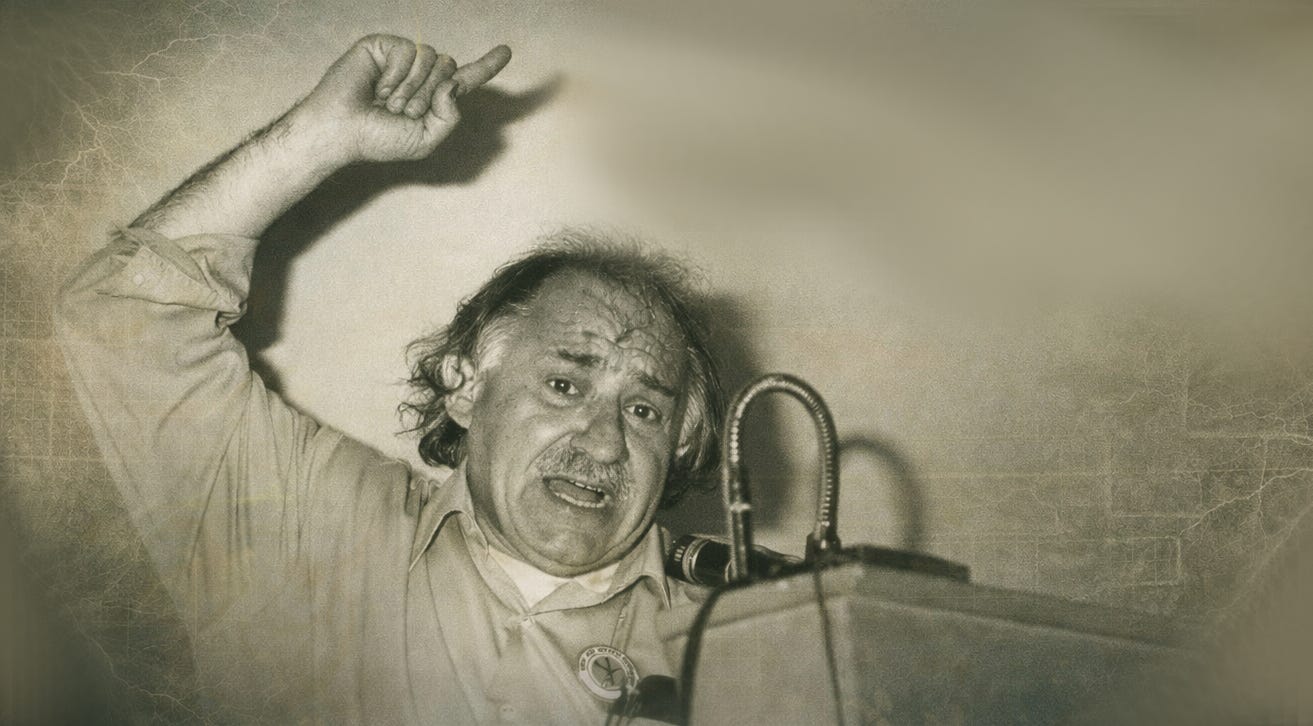
Murray Bookchin gave us a name (and a backbone) for something many people knew and sensed long before they had a theory or terminology for it: the fate of forests and the fate of people are braided together.
Born in 1921 to Russian-Jewish immigrants and radicalized in Depression-era New York, Bookchin moved from labor organizing into ecological politics; his core works (*Post-Scarcity Anarchism*, *The Ecology of Freedom*, and *Urbanization Without Cities*) braided history, anthropology, and political theory into a practical, municipalist horizon.
He refused the comforting fiction that “the environment” sits somewhere outside of us, waiting to be protected by better technology or greener consumption. For Bookchin, the domination of nature grows from domination among people; dominating hierarchy is not an accidental blemish on social life but the deep grammar of exploitation, and it inevitably radiates outward into our soils, waters, and air. Social ecology, as he framed it, is therefore not a mood or a metaphor. It is a political project to dismantle domination, build decentralized, democratic, confederated institutions, and recompose daily life so it cooperates with the rest of life.
Weather has always swung; droughts and floods predate industrial society. Social ecology doesn’t deny natural variability; it asks why a dry season becomes famine for some and inconvenience for others, and how inequality, land use, and water governance amplify or buffer shocks. And in our moment, industrial society often “loads the dice” toward harsher extremes and deeper uncertainty in many regions.
This dedication is also a proposal: social ecology needs not only sharp critique of domination, but a widely shared, everyday grammar for making and keeping promises at scale … so decentralized, democratic institutions can coordinate food, care, repair, and reserves without recreating hierarchy.
Social Ecology has many dialects now days, but its political spine is the same: ecology and freedom rise or fall together.
The term has traveled since he first sharpened it. In the academy: political theorists, radical ecologists, and libertarian socialists still work squarely in Bookchin’s lineage, where ecology and freedom are inseparable.
Sociologists, public-health researchers, and urbanists often use “social ecology” descriptively to track how populations, institutions, and environments co-evolve and how inequalities map onto toxic exposure and resilience. In sustainability and resilience science, the phrase folds into social-ecological systems, commons governance, and adaptive management - concerned with feedback loops between institutions and ecosystems.
Outside academia, the words are rarely household currency, but the practice is everywhere: permaculture guilds and watershed councils; regenerative farms and community land trusts; commons boards and mutual aid networks. In silence, people do social ecology.
At the same time, scholarly uses can drift into systems jargon that maps feedbacks while muting power; naming this drift matters, because a “social ecology” that forgets hierarchy can become ecological management by other means.
To honor Bookchin is to keep his strengths alive and to test their edges. He did three things with unusual clarity.
First, he bound ecological crisis to hierarchy at its roots and would not let us imagine a clean planet on top of dirty politics.
Second, he argued for institutions as living organs: municipal assemblies, federations of councils, public administration that is competent without being statist, and cooperative economies that are not simply markets dressed in homespun. Late in life he rearticulated this as Communalism (an explicit, post-anarchist municipalism) and argued sharply against forms of anarchism that treated personal expression as a substitute for building durable public institutions. The fire helped clarify stakes, but it also burned bridges; today we can keep the rigor while softening the sectarian edge.
Third, he demanded a culture of competence … practical, transparent, accountable. Movements should grow food, repair neighborhoods, run schools and clinics, and deliberate in public. The rhetoric should be as sharp as needed, but the work should be steadier than the rhetoric.
It’s also important not to underplay feminist, Black, Indigenous, decolonial, and other traditions that long linked ecology to anti-domination. Those lineages have deep roots that stretch long before Bookchin, and it is honorable to center them as co-equal foundations rather than later add-ons.
And yet, even with all that foundation, gaps remain. We have become fluent in critique … naming domination, enumerating harms, mapping extractive supply chains. What we still lack, in many places, is a widely shared grammar for the daily metabolism of a free society. Who promises what to whom? Under what limits? How is value recognized - by whose index, with which guardrails, and according to which local capacities? How does memory hold - so that trust does not depend on charisma or proximity alone? This is where “rooting into protocol” meets “rooting into the soil.”
By “protocol,” I mean a lightweight grammar communities can actually use. A practical form is a commitment pool: a stewarded ledger that (1) registers redeemable commitments, (2) prices swaps via a public value index, (3) enforces per-voucher and per-account limits over time windows, and (4) custodians assets so seed deposits and swap can happen with receipts and recourse.
Soil is place: watershed, season, kinship, history.
Protocol is practice: the clear, sturdy agreements that prevent runs on shared resources and allow cooperation to compound.
One way communities make that grammar tangible is to treat commitments themselves as first-class citizens. Instead of building everything on money, we notice that most meaningful exchanges start as promises: a bag of maize after harvest; a day of childcare next Thursday; a door repaired before the winds return; even a local cash token redeemable for staples. Those promises can be expressed and formalized as vouchers with plain redemption terms and finite windows, kept in a common registry … a pool of unclaimed commitments that anyone can read. People issue what they’re ready to fulfill; others accept and redeem; stewards watch the flow, adjust values and limits, and keep the memory honest. Value is not decreed from nowhere; it is indexed to local priorities and capacities, tuned by governance and, where helpful, fed by oracles. Limits are not punitive; they are the social expression of ecological and logistical reality.
In that sense, a pool is less like a market and more like a living organ, where community credit and community debt breathe against each other with rhythm. This can look like “local money / community currency,” or mutual credit at first glance, but the center of gravity is different: vouchers are specific redeemable commitments with explicit terms and windows; the pool is curated (what counts is listed), indexed (valuation is public and governed), and throttled (limits prevent runs and predation); and redemption is a first-class outcome, not an afterthought. The goal is not a universal token or coin - it is accountable promises that can compose and route value without dissolving into abstraction.
The point of Commitment Pooling Protocol is not to engineer life but to learn from it. It is to let many small circles coordinate without being swallowed by a single, managerial center. Pools can overlap when they list the same commitments; vouchers for carrots grown in the valley, care hours in town, a stable redeemable at the co-op. Then value can route sideways across neighborhoods and bioregions the way mycorrhizal networks route nutrients under a forest.
Protocol doesn’t replace political struggle or reparative justice; it only makes everyday reciprocity and generative justice legible, enforceable, and harder to hijack.
Power remains distributed, not because we fetishize smallness, but because the architecture makes capture difficult and exit possible. (anti-fragile)
Note the same bridges that route value can carry toxic flows; pools as transparent agreements on transparent ledgers publish routing allow/deny lists, throttles, and clear pause criteria so interoperability does not become a siphon.
Stewardship, in that world, is not isolated heroism. It is the humble craft of curation, valuation, limitation, and settlement, recorded in auditable logs, with pauses and circuit breakers when the weather turns. Steward power should be bounded and visible. In practice, that means: public logs with clear reason codes for value/limit changes; rotation or term limits for stewards; recall/appeal paths; multi-signature or council sign-off above thresholds; pre-declared pause criteria and restart checklists; separation of duties (valuation vs custody vs dispute handling); and a clear right to exit (predictable redemption, migration, and forkability).
The Rift with Deep Ecology
Bookchin’s famous quarrel with Deep Ecology still matters. He was alarmed by any biocentrism that slid into contempt for people, or by a spirituality that bypassed power. He asked, again and again, whether our love for nonhuman life translated into dismantling hierarchy where we live, whether our reverence for rivers came with public institutions capable of protecting them.
It is also fair to distinguish between Deep Ecology’s philosophical humility (à la Arne Næss) and strains that slid toward contempt for people or a retreat from politics. A generative synthesis is a more-than-human civic humanism: protect beings and habitats *by* building democratic power, not instead of it.
Today, we can meet that critique without caricature. A deep social ecology holds on to the awe and humility many found in Deep Ecology and weds them to the hard, daily work of democratic coordination. It says: yes to the sacredness of more-than-human life, and yes to budget spreadsheets and public ledgers; yes to gratitude rituals at the river, and yes to bylaws that keep the river free.
I feel that if he were with us now, Bookchin would be pleased by the quiet competence of countless local efforts and impatient with our lingering abstractions. He would cheer a neighborhood that federates its garden councils and rewires its school cafeterias to buy from within walking distance; he would ask to see the public logs. He would press cities to recognize assemblies, pools, and commons boards as civic infrastructure, not weekend hobbies.
Beyond liberal democracies, municipalism faces different constraints - centralized states, patronage, conflict. The task is to adapt its bones (assembly, federation, public memory) without importing risk, using redundancy (analog + digital), rotation, and diaspora links for safety.
The aim in municipalist practice is to confederate capabilities without recreating a managerial state. Confederation vs. federation:
Confederation keeps power revocable and closer to the member communities …. coordination without a center that rules.
Federation concentrates more sovereign authority in the center … coordination that can more easily become command.
A common critique is that Bookchin’s municipalist vision is inspiring but under-specifies how it survives confrontation with entrenched state and capital … how assemblies keep provisioning when credit is cut off, supply chains are squeezed, or repression escalates. One way to answer that gap is to treat coordination itself as infrastructure: a commitment pool gives assemblies a practical economic substrate by registering redeemable commitments (food, care, repairs, staples) as vouchers, swapping them through a public value index, and enforcing windowed limits that prevent runs in moments of panic. In other words, it converts “dual power” from a meeting form into a capacity to keep clinics stocked, schools fed, repairs scheduled, and stipends paid … while making crisis decisions auditable through logs, reason codes, and rule-bound pauses rather than improvisation or charisma. Confederation then becomes materially real: overlapping pools can route commitments across municipalities without requiring a central managerial authority, increasing resilience through redundancy and making capture harder by design.
I think he would continue to push us to confederate without creating a new managerial class: overlapping councils and ledgers that can talk to each other, route commitments across watersheds, and still let each place set its own limits. He would demand operational clarity: publish the value index, make limit policies public, log every swap and redemption, and keep emergency pauses rule-bound and visible.
He knew as well that assembly fatigue is real. Sortition for oversight committees, stipends for care labor and facilitation, child-care and translation at meetings, and hybrid asynchronous channels make democracy livable rather than sacrificial. And he would insist that the culture remain human-scaled …. rotate stewardship, celebrate fulfillment, make exits predictable, and keep the doors open to newcomers.
This is also where meeting culture touches the roots. It is tempting to let the loudest or most fluent take the room. A simple habit breaks that spell. Begin with a shared observation of what happened, name how it affected people, articulate the underlying need or value at stake, and make a specific request … who will do what by when. These four moves (observation, feeling, need, request) sound soft until you try them. They are not therapy imported into politics; they are political hygiene.
Still, tools like NVC can be misused to police tone or displace power analysis. The remedy becomes clear: That feelings matter, and so do structures; we surface both in the same room.
They keep power honest, keep conflict generative, and keep groups from confusing intensity for effectiveness.
What does it mean, then, to root into protocol and root into the soil? It means we nourish the conditions that make promises reliable and redemption graceful. Protocol, here, is a commons of agreements that protect us from both panic and predation. Soil, here is the living ground that sets the pace - rainfall and dry seasons, calving and harvest, the time it takes for a child to grow, the time it takes for a debt to be redeemed and trust to grow. When protocol and soil align, economics stops being an abstraction and becomes a metabolism.
Rooting into soil must also reckon with who has been dispossessed of it. Land back, water rights, and reparative and generative investment are not adjuncts to social ecology; they are tests of it, especially on climate frontlines where extraction and racialized harm converge. Credit is not a permission to overreach; it is the room to act within limits. Debt is not a stigma; it is the public memory of what we owe each other until we make good.
Social ecology, at its best, is the study and practice of how human relationships form the living conditions in which communities and ecosystems either regenerate or collapse. It understands society as a living system shaped by power, care, communication, limits, and reciprocity, and it sees environmental health as inseparable from social health. Or, more poetically, it asks not only how humans affect nature, but how the quality of our relationships becomes soil for life itself.
To dedicate this work to Bookchin is to keep his provocation intact while softening none of its demands. He did not ask us to be greener consumers; he asked us to become worthy neighbors and builders of free institutions.
I would like this dedication to be as practical as he would have pushed to make institutions edible and evidential: gardens and ledgers, councils and receipts, mycorrhizae and commitment pools. Learn to move .. as movement organizers say: “at the speed of trust”. Publish what you promise; redeem what you publish; adjust limits before a run; pause when you must; resume with care.
Build dual power openly: strengthen municipal assemblies, cooperatives, and commitment pools while contesting and reshaping city charters and budgets. Let each gain make the next one easier.
Name what remains undone, and keep going. If we do that, the phrase he minted will keep earning its keep. We will have honored Murray Bookchin not by reciting him, but by building the living, democratic ecologies he knew were possible … rooted in protocol, rooted in the soil.
I believe Murray Bookchin’s faith was humanist in the broadest sense: that people, given real means and real responsibilities, can grow into freer relationships with each other and with the earth. Holding that faith (critically, joyfully) is the work: rooted in soil, and in agreements we can actually keep.
 | A guest post by
|
The strength of the commitment pool protocol seems to me to be capable of enrichment from a complementary angle. To support my approach, I wish to cite this passage which revisits a number of elements that I will reuse (even though the complete text is much richer and more complex than the excerpt I choose to serve my point):
"In this sense, a commitment pool resembles a market less and a living organ more, where community credit and community debt breathe against each other with a rhythm. It may resemble 'local money/community currency,' or mutual credit at first glance, but the center of gravity is different: the vouchers are specific repayable commitments with explicit conditions and windows; the pool is 'curated' (what counts is listed), indexed (the evaluation is public and governed), and limited (limits prevent runs and predation); and repayment is a first-class outcome, not an afterthought. The goal is not a universal token or coin - these are responsible promises that can compose and route value without dissolving into abstraction."
The end of the text would allow for differentiating currency (universal tokens or coins) from responsible promises. These responsible promises would possess the power to avoid dissolving into abstraction.
This end of the text could therefore imply that abstraction would lose us. Abstraction in itself is a psychic faculty that can help us. I willingly give the example of the questioning of Ptolemy's geocentric system in favor of Galileo's heliocentric system. The adoption of the latter was quite long and difficult given the upheaval it implied. It was a form of decentralization of power, which is never without consequences...
Abstraction has been studied more specifically or more scientifically by the psychologist Peter Wason, who left a strong mark with his test of the 4 cards A-D-4-7.
The classic Wason selection task:
Four cards are placed on a table, each with a letter on one side and a number on the other. The visible faces are: A, D, 4, 7. The rule to verify is: "If a card has an A on one face, then it has a 4 on the other face." Participants must choose which cards to turn over (and only those) to verify whether the rule is true or false."
The answer is easily found on the internet. The interest of this task for my point lies in the series of results that this test revealed.
The correct answer from an individually tested public is only 4%.
96% of people do not find the correct answer. https://www.psychologyinaction.org/2012-10-07-classic-psychology-experiments-wason-selection-task-part-i/
Many studies have been conducted based on this test, but two results seem particularly relevant to the commitment pool protocol.
1) A group of 4-5 people together raises the success rate to around 60%.
2) If the "abstract" cards are changed to a proposition related to an experiential lived reality, and no longer "tokens" of numbers and letters but products concretely used daily, the correct answers become higher than 70%.
The commitment pool protocol therefore combines the two success conditions of this task. That is, the possibility of making abstraction explicit. This protocol, compared to mutual credit or currency which individualizes abstraction, therefore has more capacity to avoid the manipulation of abstraction for personal ends or for purposes of domination through differences in abstraction capacity. This implicitly favors the creation of trust, which reverberates in coherence. It pushes "insider trading" to the margins.
The need for concreteness (Earth) does not exclude the need for abstraction (sky), just as earthly rivers do not exclude celestial rivers (https://substack.com/inbox/post/183052578). The two kinds of rivers are therefore interdependent, just as the psychic and the biological are. The biological metaphor can sometimes tend toward the exclusion of abstraction, but we are not quite ants or mycelium. The mental dimension of the human being allows them to abstract themselves from their direct sensory context... also for the worst. In my opinion, this faculty simply needs to be re-evaluated, limited (regulated), and exchanged within an ethical commitment pool. This is obviously already the case in many areas, but old patterns easily reappear under stress.
It therefore seems to me that this protocol deserves to be developed and deepened to give it a dimension on a larger scale. For this, validation both through direct experiences and through solid conceptual formulation is, in my view, underway.
just like the end of "can we scale trust" The honest conclusion isn’t despair - it’s design work.
this conceptualization can be enriched with different points of view, and I appreciate the various comments that illuminate this work from different angles.
He did not ask us to be greener consumers; he asked us to become worthy neighbours and builders of free institutions.