
Renunciation and the Commons
Buddhism, Bhutan, and Shared Abundance

I grew up in California around Buddhist sanghas. The forms of practice were familiar to me long before I understood their historical context. We sat, chanted, walked, washed dishes, swept floors, listened to talks about compassion and impermanence, and tried to be honest with our own hearts and minds. It was good medicine for me. But I did not really know what kind of world Buddhism first arrived in, or what kind of world it was responding to.
Years later, living in Kenya, I began to recognize something I had not known how to name as a kid. I kept encountering abundance that did not look like familiar wealth. It looked like people who could rely on each other. Rotating labor and mutual support. Shared rules about land and harvest. Trust that moved through the community like water in a living system. In Kenya, I have watched reciprocity act as infrastructure. It is how life holds together.
I have seen it in small, ordinary scenes: a group arriving early with hoes and laughter to help a neighbor weed before the rains, someone quietly leaving a sack of maize for a family that had a hard month, an auntie keeping track (without writing anything down) of who has given, who is struggling, and who will be back on their feet soon.
What moved me most was not only the efficiency of these systems, but the care inside them. People do not help because they are saints. They help because they know they belong to each other, and because life is uncertain. This feels close to what Buddhism calls interdependence (and to what His Holiness often calls universal responsibility).
These practices are not vague kindness. They are organized. People keep an informal memory of who has contributed, who can ask, and what is fair. There are shared limits (so the commons is not drained), shared ways of valuing unlike contributions (time, food, tools, care), and shared places where value is held (a store, a herd, a savings group, trust that can be relied upon). I did not have a name for this pattern then, but it is the pattern I eventually started calling commitment pooling. I do not mean this as a new ideology. I mean it as a simple way to describe something very old (how communities make promises, keep them, and protect shared resources over time).
~*~
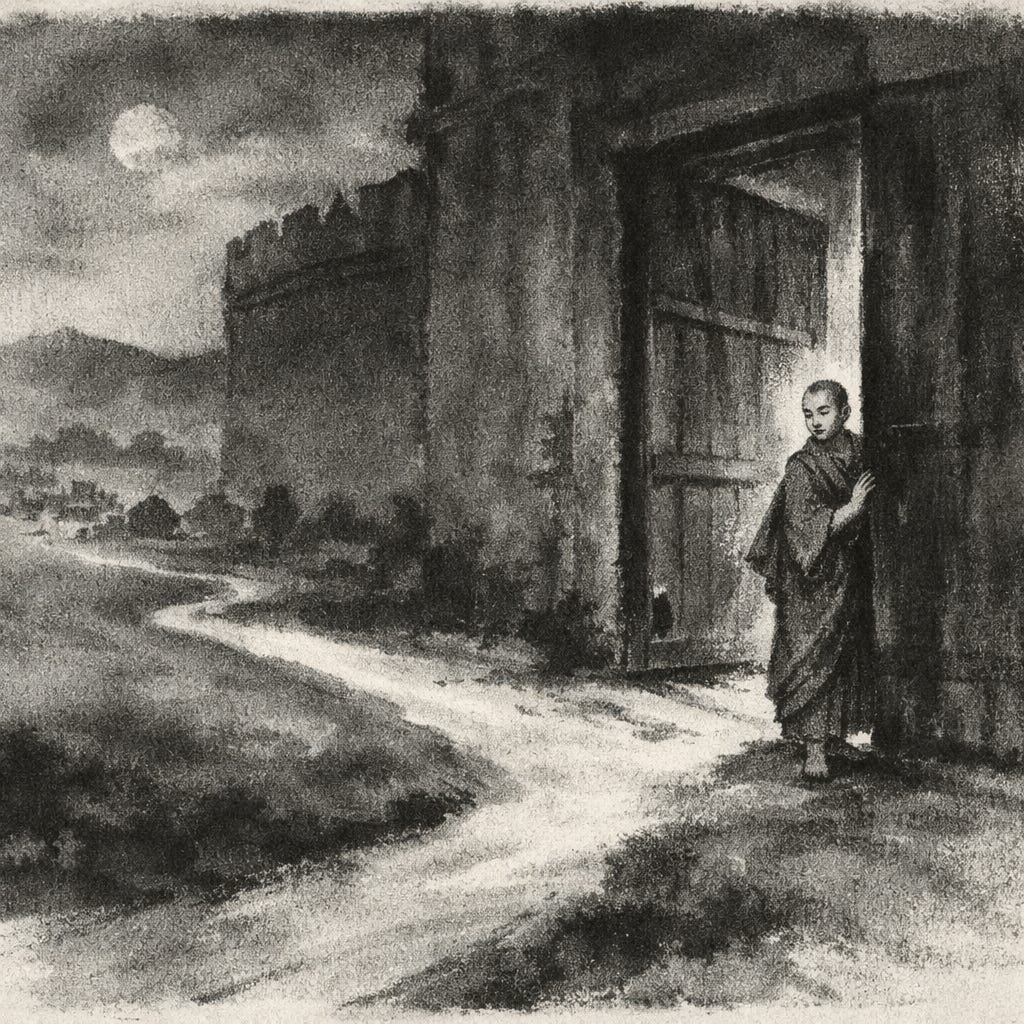
The other night after meditation at my sangha here in Kenya we read a text (thanks to Melita our host) by His Holiness the Dalai Lama of Buddha’s origin story (a young man living a protected life, who chooses to leave his home, a palace no less, so he can understand suffering directly).
His Holiness writes, “Siddhartha’s renunciation … symbolises the practice of the training in morality.” (Message to the Global Buddhist Congregation, New Delhi, November 27 to 30, 2011, Office of His Holiness the Dalai Lama).
While I resisted the focus on suffering, that line stayed with me. It made me curious about the era Buddhism came from, and about the social systems sitting behind the image of a palace.
What follows is a series of reflections that connects three threads: the Buddha’s departure from enclosure, the sutras (ancient text) that describe the fall of abundance into scarcity, and the ways Buddhist ethics can help protect and grow commons (Bhutan as a living example). Along the way, I introduce a my usual practical lens (commitment pooling) that I first recognized in Kenyan reciprocity practices, and later realized is deeply compatible with Buddhist training.
Before I go further, one note of humility. Buddhism has been part of my life since childhood, but I am not a scholar or a monastic. I am still a novice student, writing from lived practice, conversation, and reading. When I say ‘in Buddhism,’ I mean ‘as I have come to understand it’ (and I welcome corrections).
Note as well that when I use the image of a palace, I am not trying to blame particular people. Buddhism usually points first to states of mind (ignorance, fear, grasping) that can live in anyone, rich or poor. Systems that cause suffering are often built from ordinary human confusion, then repeated until they feel normal.
The palace was not just a building
In the Buddha’s time, society was changing quickly. The Buddha’s life is remembered in a landscape of northern Indian states, trade routes, and agriculture. Scholars generally place the Buddha in northern India in the broad period from the sixth to the fourth century BCE, with traditions locating his early life among the Shakya community near Kapilavastu and his death among the Mallas. This was also an era of rising regional powers (including Kosala under King Pasenadi) and growing trade and taxation capacity along the Ganges routes.
That matters because the “palace” is more than a personal drama. It also symbolized the political economy of that time: systems that manage surplus, organize labor, enforce boundaries, and keep certain suffering out of sight for those within. The word enclosure feels useful here, because it names a common turning point (when shared resources become privately guarded, and trust begins to thin).
Commons, and the moment they get enclosed
A commons is a shared resource governed by a community’s rules. A commons is not a free-for-all. It is shared access plus shared limits, held by relationships, reputation, and agreed practice.
For instance, rotating labor (the kind I see in Kenyan reciprocity practices where I live) is a commons of time and effort. It works because people share trust, and because the rules are remembered.
Enclosure is what happens when shared resources and shared rules are converted into bounded control (often backed by force or state authority). The material effects can look like scarcity. The social effects often look like fear, punishment, and loss of trust.
The early sutras do not use the word “enclosure,” but one of them describes the mechanism with great clarity.
The Buddha’s origins as a warning about the fall of abundance
The Aggañña Sutras (DN 27) is a story of origins. It is not a literal history. But it is an ethical and political story about how suffering becomes systematic.
It begins with beings living in a kind of effortless provision (abundance). It describes a phase where rice is naturally available and self-restoring: “What they took … had grown back and ripened.” (Aggañña Sutra, DN 27, translation by Bhikkhu Sujato).
Then comes a turn where people begin to hoard (accumulating). Scarcity appears. The rice changes. Traces remain. Harvest no longer regenerates in the same way.
And then the line that sounds like the first fence, the first property boundary in the soil: “We’d better divide up the rice and lay down boundaries.”
Immediately, the cascade follows. Once boundaries exist, theft becomes meaningful. Blame becomes meaningful. Punishment becomes meaningful. A certain type of governance becomes necessary.
So the sutra describes the invention of a ruler to manage the harms that appear after enclosure. The community agrees to pay that person (a tax) from the harvest, “a share of rice.”
Read as a political ecology story, the sequence is simple: (abundance) then (craving and hoarding) then (boundaries) then (theft and violence) then (punitive authority paid by extraction)
Buddhism might describe the fuel underneath these steps as the familiar poisons (grasping, aversion, and confusion). When those states spread through a community, they do not remain private. They shape rules, economies, and the way people treat each other.
This is why the palace image matters to me. The palace stands inside this world: a world where boundaries, surplus, and coercion have already arrived. The prince leaving home can be read as stepping out of insulation and into the machinery of suffering.
But Buddhism does not stop at diagnosis.
The path is a method for reversing the inputs that destroy commons
The Buddha’s core teaching begins with the Four Noble Truths. In SN 56.11, this line sets the tone: “Now this is the noble truth of suffering.” (Dhammacakkappavattana Sutra, SN 56.11, translation by Bhikkhu Sujato)
And the way out is a training path that reduces the causes of suffering. The Noble Eightfold Path is summarized in straightforward terms: “right view, right thought, right speech, right action, right livelihood, right effort, right mindfulness, and right concentration.”
His Holiness the Dalai Lama frames the Buddha’s own life as a teaching in the three higher trainings. He writes that renunciation symbolizes morality, asceticism symbolizes concentration, and awakening represents wisdom.
What happens when we place those teachings next to Aggañña?
The Aggañña collapse is driven by mental and social forces: craving, vanity, short-term comfort, and then violence and punishment.
So Buddhism’s response is not just to build a better fence. It is to train the mind and the community away from the forces that make fences turn into suffering.
(Morality) reduces harm and makes trust possible.
(Concentration) reduces reactivity, panic, and the contagious fear that triggers runs.
(Wisdom) reveals interdependence, so “my good” cannot be separated from “our good.”
This is exactly the kind of inner and outer stability that lets commons remain commons.
I am always looking for living examples where ethics, institutions, and ecology still reinforce each other, where commons do not automatically collapse into extraction.
Bhutan
I have not yet been blessed to visit Bhutan, but I offer it respectfully as a living example of commons protected and strengthened by Buddhist culture.
Bhutan is not a museum. It is a modern country with real tensions. But it is special because Buddhist values, customary practice, and state policy have been unusually aligned around stewardship and community vitality. In other words, Bhutan lets us see reciprocity at multiple scales: household labor sharing, village seasonal rules, and national policy.
Seen through the simple lens of commitment pooling, these practices all combine four things (clear commitments, shared ways of valuing contributions, limits that prevent overuse, and shared reserves that make promises real).
You can see ancient and modern commons patterns that resemble reciprocity based economics I see in Kenya:
Rotating labor and mutual aid in farming
Bhutan has documented labor-sharing practices. One example is latsab, described as labor sharing on a rotation basis among land users. Another is pchu, described as a common labor exchange practice in agriculture, linked to labor scarcity on farms.
These are commons of labor: contributions rotate, benefits rotate, and social membership enforces fairness.
Seasonal closures as commons governance
Bhutan also has community closure practices that function like ecological commons regulation. A study of eastern Bhutan documents the tsensöl ritual used to “seal” territory and prohibit entry to higher mountain reaches, and describes how it precedes a community mountain-closure period (ladam).
Another study describes “closure” of mountain peaks during spring and summer tied to protector deity obligations, noting that the closure coincides with maximum plant growth.
Whether you interpret these as spiritual obligations or ecological governance (or both), the functional effect is the same: communal limits timed to regeneration.
Modern commons scaled into institutions and law
Bhutan’s community forestry is a major modern commons institution. Bhutan’s National Strategy for Community Forestry describes a reversal from nationalization and centralization toward devolution and decentralization, with management devolved down to local communities through Community Forests.
Bhutan also has a strong constitutional and policy commitment to forests. A World Bank note states that the constitution mandates at least 60 percent forest cover be maintained “in perpetuity.”
This is a rare example of a national commitment that protects a core commons condition over time.
Gross National Happiness as a partial measurement of abundance
Bhutan’s Gross National Happiness (GNH) index is a measurement framework that uses 33 indicators across nine domains. The domains include community vitality and ecological diversity and resilience, which point directly at the kind of “abundance” I have been noticing in Kenya (not merely income, but the lived capacity to rely on each other and on a healthy landscape).
The OECD notes that Bhutan’s GNH surveys gather data on these domains and indicators, and that the index is calculated using the Alkire-Foster method.
So Bhutan is special today because it has tried to keep “progress” tied to social and ecological wellbeing, not to extraction.
At this point, the question is not whether commons exist here. It is whether we can describe them clearly enough to protect them, measure them without reducing them to reductive statistics like money, and help them interoperate across communities without triggering the Aggañña collapse.
Deriving the four protocol functions from Buddhism
Now I want to turn the lens around.
If a commitment pooling protocol is a stewarded system that registers intentions that hold commitment, maintains values, enforces limits, and helps settle exchanges, then each of those four functions already has a close cousin in Buddhist practice.
This is about noticing that Buddhism is already a sophisticated governance system for desire, trust, and distribution. A Buddhist caution is essential here. Any system that tracks value flows can also feed grasping and comparison if the motivation is not clear. Without ethics and compassion, even a well designed protocol can become a new way to accumulate and exclude. So the inner training is not optional. It is the safeguard.
1) Commitment Registry (clarify what is being promised)
A commitment registry is simply a shared list (memory) of what counts as a valid claim or promise.
In Buddhism, the deepest registry is ethical: what actions are skillful, what actions are harmful, what commitments we undertake. The Eightfold Path begins with right view and right speech, because communities collapse when truth collapses.
In practice, the sangha also becomes a living registry. People take vows, enter training, and are held by a community that remembers what has been undertaken.
A formalized commitment is a clear intention, described in plain language (who owes what, to whom, by when, with what proof). This is a version of right speech applied to economic life.
2) Value Index Registry (how we compare unlike things without losing wisdom)
A value index is a way of pricing exchanges and prioritizing what matters.
In Buddhism, valuation is guided by the reduction of suffering. The Four Noble Truths are a valuation system: they identify what is painful, what causes pain, and what ends it.
Aggañña adds another crucial insight: when the community’s “value system” rewards hoarding, abundance collapses into scarcity.
The value index should not only track market scarcity. It should track what protects shared life. That can include ecological regeneration, community vitality, and fairness. Bhutan’s GNH domains are one example of how a society can encode those priorities.
So a Buddhist-derived value index asks: does this exchange reduce suffering and strengthen conditions for wellbeing, or does it accelerate the Aggañña cascade.
3) Exchange Limiter (limits that prevent runs, hoarding, and enclosure)
A exchange limiter is a guardrail: limits per commitment and per time window that prevent extraction and panic.
Buddhism is full of limiter logic. His Holiness highlights morality as the first training, because restraint is what keeps desire from turning into harm.
And the Vinaya (the framework of discipline, rules, and regulations governing the Buddhist monastic community) shows very practical limiters on accumulation (for example rules limiting how long extra bowls can be kept).
Bhutan’s closure practices are also limiters in ecological form: sealing territory and restricting harvest during sensitive seasons.
Limits are not punishment. Limits are compassion made operational. They keep a commons from becoming a race. They stop the early stages of the Aggañña fall (store up, fence off, fight).
4) Holdings and Settlement (custody, distribution, and trustworthy redemption)
A vault is what holds the shared reserves (grain stores, forest inventory, community funds) and settles exchanges according to the rules.
In Buddhism, dana (giving) and communal support are core infrastructure for the sangha and for householders. The sangha is, in a sense, a living settlement system: offerings flow in, teaching and care flow out, and the whole thing only works when trust is protected.
In modern Bhutan, community forestry devolves management and creates shared governance over forest assets. And the constitutional forest mandate protects the long-term reserve itself.
The shared reserve is where commitments become accountable. It makes redemption possible. It also makes accountability possible, because everyone can see inventories, rules, and settlement events.
Why this matters
The Buddha’s origin story begins with leaving a protected enclosure and learning to see suffering clearly. His Holiness emphasizes that this is not only biography, but training.
The Aggañña Sutra gives a mythic diagnosis of how abundance collapses when craving becomes governance: boundaries, theft, violence, extraction.
Bhutan is a living example of how Buddhist ethics and institutions can help preserve commons and even scale them into national policy (community forestry devolution, constitutional forest protection, GNH measurement).
And Kenya has shown me that living reciprocity still exists, often outside formal markets, often older than our modern institutions, and often more reliable in crisis than money. At the end of the day, this is not mainly a theory problem. It is a care problem: how do we help communities keep promises, share fairly, and resist the drift from abundance into guarded scarcity.
Part of care is seeing clearly. When we can name the commons patterns (what is shared, who belongs, what the rules are, what the limits are, where reserves live, how conflicts are handled) we stop treating them like accidents or folklore. We can defend them from extraction (when outsiders or elites siphon value) and from enclosure (when shared access quietly becomes private control). And we can do something else that is hopeful: connect commons to commons. Not by centralizing them, but by confederating them (many local systems that stay locally governed, while learning how to cooperate across distance through shared standards, mutual recognition, and bounded routes of trust).
Seen this way, commitment pooling is not a new invention I am trying to add on top of Buddhism. It is simply a practical way to describe, and therefore protect and gro, the conditions of trust that Buddhist training already strengthens, (in short):
register commitments clearly (right speech made legible)
value what reduces suffering (right view made measurable)
limit extraction and panic (restraint made operational)
hold and settle reserves transparently (dana and stewardship made durable)
That is how we measure and grow abundance without repeating the fall described in Aggañña.
And for me, it brings the story of leaving the palace into the present as a daily practice of protecting what we share. My hope is that this way of seeing helps us reduce suffering in practical ways, and helps communities protect and grow the conditions for dignity, generosity, and peace.
Although I tend to steer away from religious discourse, I still like the article a lot. My personal approach is more utilitarian so I'll continue from that perspective.
Perhaps bringing to light three underlying themes would strengthen the sociopolitical appeal of Commitment Pooling.
1. Distinguish between deadly or 'existential suffering' and 'aspirational suffering'. A person has to be alive and somewhat functional before s/he can have aspirations, make commitments, or withdraw goods or services from the pool (excluding grave marker expenses which we can attribute to the survivors). Popular discussions of suffering and poverty often ignore this important functional boundary. 'Suffering hunger' provide a useful example. We use similar language to describe people who are a) within a week or two of death from lack of any nutrition, b) living on diets that may contribute in the long term to disease or shorter life expectancy, and c) healthy and eating full meals but may be dissatisfied with the variety or taste of what is on offer leading to a personal feeling of 'hunger'. Each of these groups may describe themselves as suffering but the consequences of their suffering with respect to the pool are entirely different. Let's be a bit more nuanced in our evaluation of the concept of suffering while continuing to honor each individual's perception of his/her personal suffering. Communities may have widely different shared values around 'suffering unto death' as compared to 'suffering from failure to accomplish an aspirational goal'.
2. Understand identity boundaries. Me-We-They boundaries vary widely around the globe. What appears as greed, exploitation, corruption, or commons depends on where the sharing community draws these boundaries. We need to include explicit identity boundaries in our attempts to make our values transparent and determine whether they are truly shared.
3. The concepts of greed, hoarding, and exploitation can only have meaning within a context of physical survival, units of identity, and perceptions of control. Early humans evolved as prey animals, not top predators. They controlled neither the availability of food nor natural disasters such as weather, fire, or volcanoes. They did not have fences or lockable doors. Under conditions of natural scarcity, the survival of their gene pool may have depended on their tendency to compete and withhold resources from other humans (greed), collect and protect whatever they hunted or gathered over time (hoarding), and both abstract and extract what they found in their environment so that they could invest in their identity group (exploitation). Our ancestors, those who survived to raise reproductively successful children, were probably those who exhibited characteristics we may not value as much today.
Now let's consider the characteristics of different human ecosystems through time.
- Early Hunter Gathers: Continuous, immediate (day-to-day) external survival threat, minimum viable gene pool (small populations), limited communication (across space or time), rudimentary enforcement techniques (no locks, go guns, no bombs, no machines), strong utility for communitarian behavior within identity boundary, strong utility for 'selfish' behavior beyond identity boundary.
- With rise of agriculture, writing, and cities: much lower external survival threat, large populations, limited communication beyond immediate location although writing increases both space and time), wide variety of identity groups with enforcement techniques available to the elite but not 'the poor', strong utility for communitarian behavior within 'empires' (noblesse oblige), wars among empires, hostility among ethnic or religious groups.
- Industrialization: locus of survival threats from other humans rather than external, gene pool secure (adequate to large population), communication technologies rapidly expanding to global, enforcement techniques expanding from privatization of pastures and forests to atomic annihilation threat.
- Today: survival threats to individuals only from human violence, accident, disease, age, or withholding resources, externalities are no longer threatening. Identify groups only threatened by violence from other groups, withholding or internal disorganization. Population secure except for war or epidemic, communication global, wide variety of identity groups with ambiguous enforcement power.
In other words, to paraphrase Pogo, we have met the enemy, overcome most of it, and the remaining enemy is the leftover psychology from our endangered past. The solution, well aligned with Buddhist philosophy, is to use training and education to overcome our spontaneous responses to perceived threat, to replace violence with compassion, fear of scarcity with productive action, tendency to create narrow identity boundaries with global empathy, and to reclaim ancient social technologies for reciprocity implemented in a modern technical context.
I hope this post isn't too pedantic to wade through. Thanks, Will, for crafting your thoughts so eloquently. Now let's get these words out so that every small town in the world has access to them!
Beautiful and life giving. I regard myself as a de-churching 'Christian' in order to disassociate with the the Western corruption (contamination) of the way and teachings of Jesus of Nazareth.
The way of being taught and modelled by Jesus resonates and echoes deeply with your writing. He too is understood to have "left the palace" to incarnate within the depths of our suffering, to "love enemies" while at the same time warning against harmful (harm causing) people (who have not yet seen the light). So your operational boundaries are relevant in his worldview too.
Agape, which he represented, can be defined as "other centred, self sacrificing, self giving, unconditional love". That kind of love, expressed in mutuality, within community, yields the kind of abundance that you describe. Not isolating or separating but engaging, inclusive, caring and kind.
Inverting my inherited worldview, to discover the loving origin of our Cosmos through Love's incarnation. Becoming brave enough to call my culture's bluff and walk away from darkness masquerading as light.
Thank you.
DJM