
Recipes - the Game
Can You Coordinate 8 Cooks and 24 Recipes?

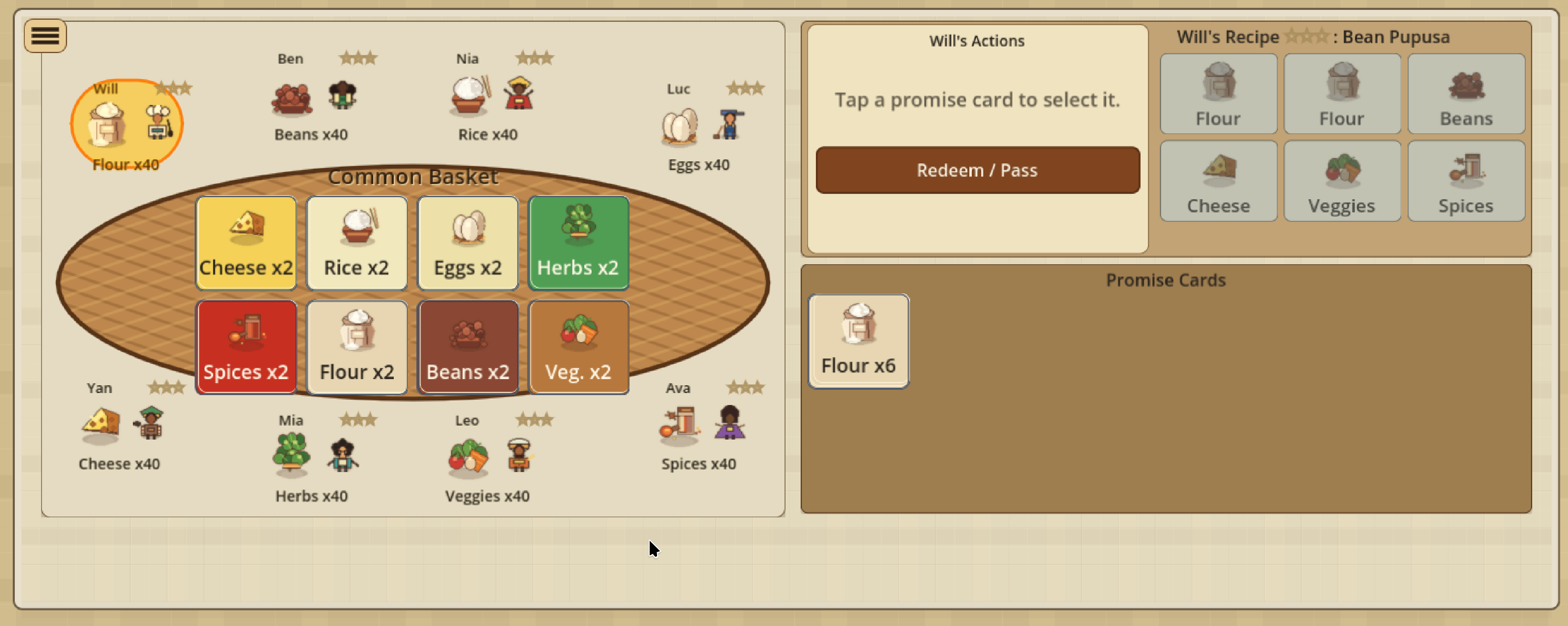
A game about promises, food, debt, settlement, and the dangerous question of whether everyone can get fed.
Here is the challenge: Can you coordinate 8 different resources, held by 8 different cooks, into 24 finished recipes?
Not without counting, trading, promises or cleanup.
That is the little world inside Recipes, a new Grassroots Economics game about cooks, ingredients, promise cards, common baskets, direct offers, shared dishes, and the part of economic life everyone likes to ignore until the table is messy: settlement.
Play Recipes: https://recipes.grassecon.org
This game is based on a card game we have used in the field for years.
Watch the walkthrough:
At the surface, Recipes is a cute kitchen game. You and seven other cooks sit around a table. One cook has rice. One has beans. One has herbs. One has eggs. Others have flour, cheese, vegetables, or spices.
Everyone has plenty of something.
No one has everything. That is where the game begins.
Underneath, Recipes is a tiny playable model of economic coordination. Everyone can offer something. Everyone needs something. Everyone can make promises. Everyone can get stuck. The table only succeeds when the group finds a way to move commitments around until real needs are met.
That is the game.
That is also a large part of economic life.
How the Game Works
Each cook begins with a main ingredient. If you are the rice cook, you have rice. If you are the bean cook, you have beans. This sounds powerful until your recipe asks for herbs, cheese, eggs, spices, and vegetables too.
So you coordinate.
But you are not tossing coins across the table. You are moving promises.
A promise card says, in effect:
I can provide this kind of ingredient when someone redeems this promise. (like a gift card or an IOU)
That means the game is more than just about what people have. It is about what people can credibly commit to provide.
In Recipes, your table can:
Put promise cards into the Common Basket, where anyone can swap useful cards.
Make a direct offer to another cook.
Accept offers that help your recipe move forward.
Redeem promises into recipe slots.
Use your own ingredient stock directly when your own recipe needs your own main ingredient.
Prepare dishes.
Share food pieces.
Settle the remaining commitments.
This is why the game gets interesting quickly.
The beginner question is: What do I need?
The better question is: What can I move that helps the whole table move?
Production Is Not Enough
The obvious goal is to make dishes. A recipe fills up. A dish appears. The kitchen celebrates.
But Recipes adds a harder question:
Can the table also settle?
Settlement means clearing the outstanding commitments so the final state is not just productive, but balanced. Who still owes what? Who is holding claims that need to be redeemed? Can the common basket return to a clean state? Can each cook finish without leaving unresolved promises scattered across the table?
In ordinary economic language, settlement sounds boring. It sounds like paperwork.
In Recipes, it feels like the kitchen after a feast.
The food is cooked. Everyone is happy. Then someone points to the pile of dishes, cards, promises, and leftovers and says:
Great. Now who cleans this up?
That is settlement.
And it matters.
A system can be very good at producing and still bad at clearing. It can make impressive piles of output while quietly building a snarl of obligations behind the scenes. Recipes makes that visible. You do not truly finish by cooking alone. You finish when the commitments are cleared and the table can breathe again.
No money does not mean no accounting. No money does not mean no debt. No money means you need some other protocol for promises, routing, redemption, and settlement. Recipes lets you play with one.
The Team Challenge
You can play solo … but it is way more fun to try this with a group.
Try it with friends. Try it in a classroom. Try it at a workshop. Try it with your kids. Try it with one adult and seven children who will immediately notice when the adults are pretending something is fair.
Set the challenge:
Eight cooks. Three recipes each. Twenty-four dishes total. Then settle all debts.
Track:
How many turns it takes to finish all 24 dishes.
How many turns settlement takes after the last dish is made.
How often players pass without moving anything useful.
Whether people notice pending offers.
Whether one ingredient becomes a bottleneck.
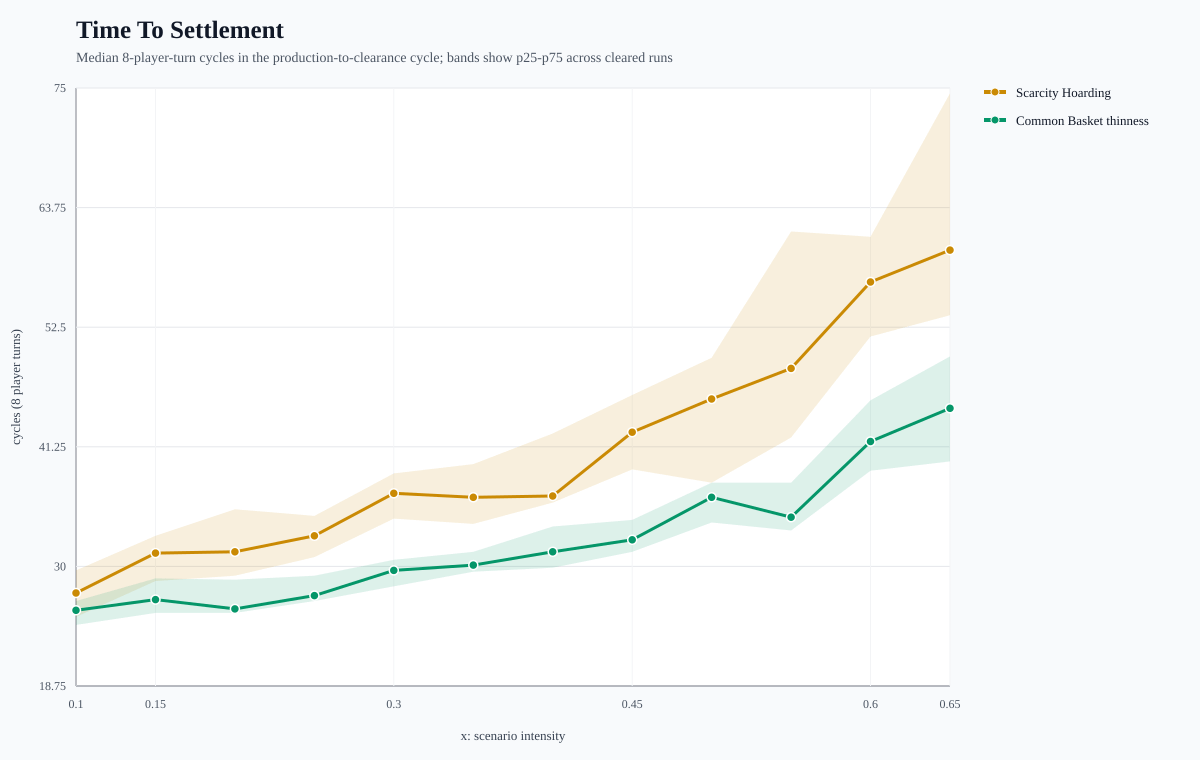
Whether the Common Basket helps or becomes cluttered.
Whether direct offers beat random swapping.
Whether everyone feels the outcome was fair.
If you are playing with kids, do not start with a lecture about economics. Ask kitchen questions:
Who got stuck?
Who had too much?
Who needed help?
What made the table faster?
What made it feel unfair?
Did anyone finish only because someone else stayed blocked?
What should the table do differently next time?
The answers are the lesson.
The Sneaky Economics Under the Apron
If you remove money but keep real needs, limited resources, memory, timing, trust, and promises, then you still need a way to coordinate. You still need records. You still need clearing. You still need settlement.
Money is one coordination tool. It is not the only possible tool.
In Recipes, the tools are visible:
Promise cards show commitments.
The Common Basket creates shared liquidity.
Direct offers route needs between specific cooks.
Redemption turns claims into real recipe progress.
Settlement clears what remains.
That is the serious idea hiding under the cute food. A community economy is not magic generosity. It is not everyone shouting “sharing!” and hoping the beans arrive. It is a living protocol for making, moving, trusting, redeeming, and clearing commitments.
The game is small enough for a child to play.
The problem is large enough to keep economists busy.
p.s. For those of us that need a gentle transition. Money could also go in the basket. Money could also be on the the ingredients someone brings to the table.
p.p.s. For those that want the bigger picture …. networks of baskets can connect and route through each other.
Games as Economic Thinking
C. Thi Nguyen describes games as an art form where the medium is agency. A game gives you temporary goals, constraints, tools, and frustrations. You do not only look at a system. You inhabit it.
Recipes attempts to use that form directly. Instead of explaining ancient coordination systems, liquidity, settlement, routing, and debt clearing with a diagram, it lets you feel them:
You need spices.
The spice cook needs eggs. The egg cook needs beans. The bean cook has an offer waiting, but they did not notice it.
Now the whole table is slow.
Suddenly “coordination failure” is not an abstract phrase. It is your burrito sitting unfinished because someone has the wrong promise card.
That is why games matter to me. They let us safely experience the shape of a problem before we try to solve it in real life.
One Protocol, Three Worlds
Recipes is part of a small Grassroots Economics series of playable coordination models. Each game shows a similar coordination protocol through a different metaphor.
Cellular:
https://cell.grassecon.org
Cellular asks: can you build a living circuit? Each cell has resources, needs, limits, and neighbors. The problem is flow. The challenge is repair. If the circuit is badly arranged, pressure builds and parts of the network starve.
Social Soil:
https://play.grassecon.org
Social Soil asks: can a community grow through relationship? It uses a garden, crops, fungi, nutrients, and village needs to show how ecology and economy are not separate. Health comes from connection.
Recipes:
https://recipes.grassecon.org
Recipes asks: can a table of people coordinate promises well enough to make everyone fed? It puts the protocol right in your hands: offers, swaps, commitments, recipes, food sharing, and settlement.
Same family of ideas. Three different feelings.
A circuit. A garden. A kitchen.
Please Play, Break, and Report Back
Open Recipes.
Gather a team if you can.
Play with eight cooks.
Make three recipes each.
Settle the table.
Then ask the question that matters:
How many turns did it take for everyone to get what they needed?
Not one winner. Not one rich cook.
Everyone!!!
If you find a strategy that works, share it. If your table gets stuck, tell us where. If your kids invent a better rule, definitely tell us. If the bots behave badly, report them. If your table collapses into chaos, congratulations: you found an economic problem worth studying.
Play Recipes here:
And keep the deeper question on the table:
What kinds of economic systems do we learn to build when we can play directly with promises, production, settlement, and mutual need?
…..
p.s. This is all open source … make it better. https://github.com/grassrootseconomics/recipes
Love the Recipes game! There is something cool, poetic, and generalizable from this game into the economic principals that should exist in the world:
1) Achieve your objectives (cook 3 recipes)
2) Help your neighbors achieve their objectives (help others make their recipes)
3) Rebalance promises (reset the system so we can make new recipes)