
Noème in Formation
A cup of tea and the many traditions that asked how a world becomes meaningful

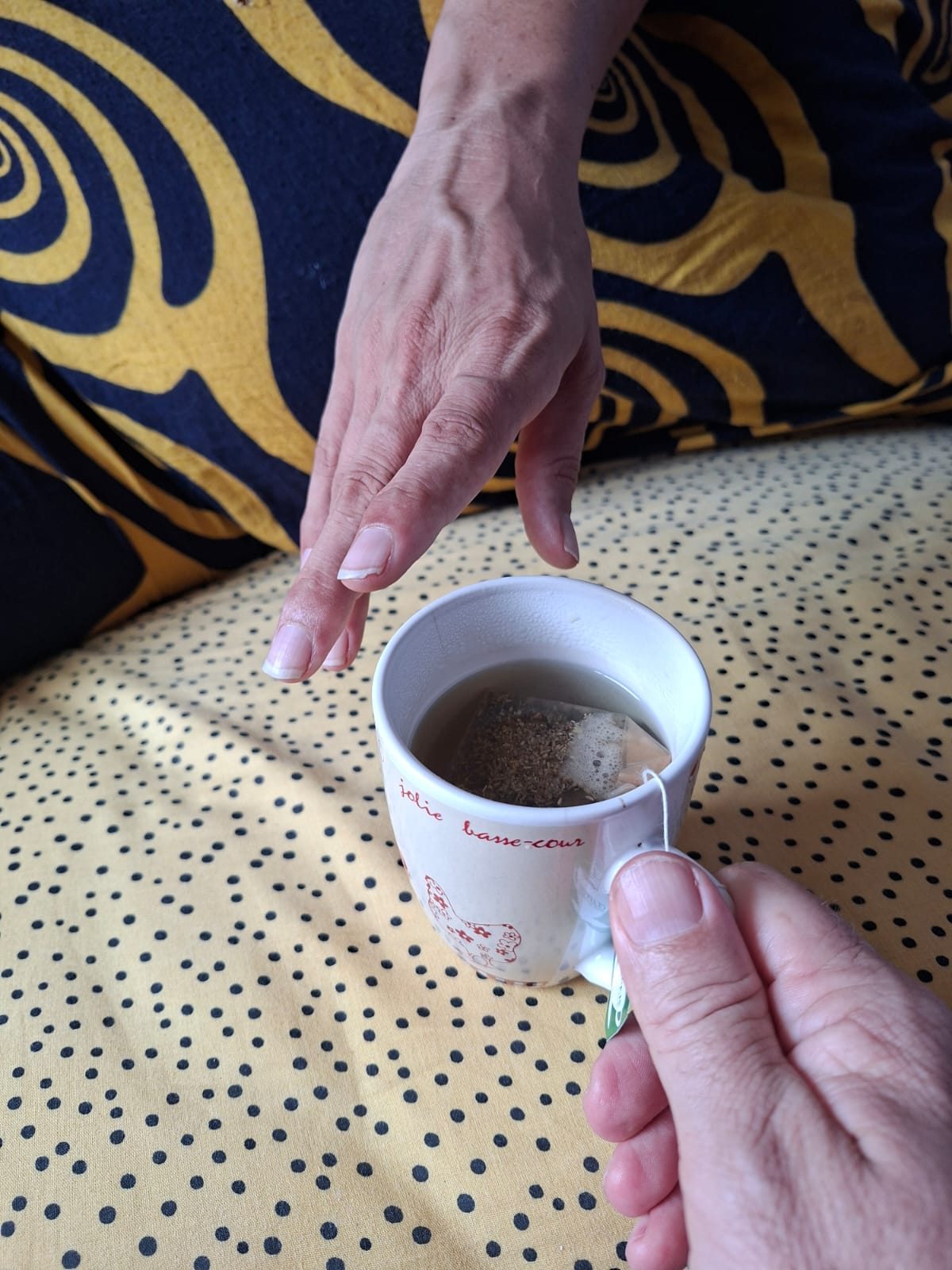
A hand moves toward me. There is a cup in it. Steam, perhaps. A glance. I am sitting in someone else’s home and something is happening .... but what? Is the cup being offered, passed, shown? Am I supposed to take it, hold it, pay for it? The event has already begun. Its meaning has not. Or maybe that is not quite right .... the meaning has begun too. It is simply not finished.
This has been following me around. I used to think perception happened in two clean steps. First raw data, then interpretation. First color and sound and pressure, then meaning. But life does not feel like that. The hand does not first appear as an abstract moving shape. It appears as a hand moving toward me. The cup does not first appear as a collection of edges. It appears as something being carried. The whole scene leans toward a possibility .... maybe an offer, maybe hospitality, maybe something else. Meaningful, but still becoming.
I gather that we humans have been thinking about this for a very long time. Plato wondered whether seeing something was the same as knowing it. Aristotle asked how separate sensations belong to one perceived thing. Indian philosophers argued about whether perception begins before concepts, how recognition happens, how error happens. Diṅnāga and Dharmakīrti asked how perception differs from conceptual construction, while many traditions more widely examined how habit, memory and prior formation shape what appears. So this is not a new question .... not even close.
Then the host smiles and says, “Please, have some tea.” Now something settles. The cup was not merely moving. It was being offered. I accept, and the event changes again. Tea as possibly offered .... tea as offered .... tea as accepted .... tea as shared. And perhaps years later, tea as remembered welcome. Same cup. Different meaning. Or perhaps one event becoming itself through time.
This is where a German philosopher named Edmund Husserl comes in. As I understand him, Husserl spent much of his life asking a simple question that becomes rather difficult once you really look at it .... how does something appear to us as something? Not just a cup. A cup as gift. A gesture as welcome. A silence as tension. A promise as trustworthy. A gathering as belonging.
He used the word noema for the thing or event as it is intended and experienced. Or, in French, noème.
Noème is very significant to me. More than I am ready to explain here. There is tenderness in it for me now .... awe, even. A sense that a word can arrive before we understand why we need it. I happened upon it by good grace, and only later began to see how much life it was carrying.
The act of perceiving, remembering, expecting or judging is an intentional act. Husserl called this side of experience the noesis. The thing or event as intended is the noema. The meaning under which it appears is its noematic sense. So the seeing is noetic. The tea-offering as seen is noematic. The tea-offering as welcome is its noematic sense.
That little word as carries the mystery. Tea as gift. Tea as debt. Tea as care. Tea as manipulation. Tea as reconciliation. The physical cup may remain the same. The world does not.
And still .... Husserl was not first. He was not the first person to notice that perception involves more than passive sensation. He was not the first to understand that memory, habit, expectation, judgment and social life shape experience. But he gave a strangely precise account of how an event appears with meaning, how that meaning develops, and how one thing remains the same thing as experience changes through time. That is why noema matters to me. It is not the first answer. It is a hinge.
The cup also comes with possibilities. I see only one side of it. The other side is hidden, but expected. The cup has weight, warmth, possible use, possible breakage. The event has possibilities too. I may accept. Refuse. Hesitate. Feel cared for. Feel indebted. Discover that payment is expected. Remember the moment forever. The cup contains tea. The event contains a horizon.
Then the host says, “Please pass this to the person next to you.” Everything changes. What looked like an offer was not an offer. Meaning is not arbitrary. The event pushes back.
This is where Buddhist philosophy becomes especially sharp. A Buddhist thinker might ask what happened first. Sensation? Recognition? Concept? Desire? Fear? Obligation? Did I receive the event as it was .... or through habits already moving inside me? Vasubandhu might press on how experience is structured by prior formation. Nāgārjuna might warn me not to turn hospitality into a thing with an independent essence. No host, no offer. No guest, no receiving. No custom, perhaps no hospitality. The event exists through relationships. Fazang, from the Huayan tradition, might widen the scene further. The cup is rain, soil, leaves, hands, fire, clay, roads, trade, custom, ancestry, the person who washed it, the person who taught the host what welcome looks like. The cup begins to contain a world.
After Husserl, the story keeps moving. Heidegger asks why we treat the cup as a neutral object in the first place. In ordinary life it is already something to drink from, pass, wash, offer, refuse. Merleau-Ponty gives the guest a body. The guest leans, reaches, smells, feels warmth, reads the room. Gibson asks what the cup allows us to do. Varela, Thompson and Rosch ask how the guest helps complete the event by accepting, refusing or hesitating. Then neuroscience arrives with instruments. It studies how sight, sound, touch, smell, memory, expectation and movement come together. It asks how signals are integrated. Husserl asks what the whole event is experienced as. These are not the same question .... but they can speak to each other.
Mweria. Mweria is a tradition of collective labor I first encountered in Kenya and now in many different forms around the world. People gather, work, cook, repair, prepare fields, care for children, remember who helped before, and know another household will have its turn. At first I thought I was seeing an institution. Then I thought I was seeing a deeper category than currency. Then I realized I was learning to see differently.
You never see the whole relational field at once. You see someone arriving. Someone absent. Someone remembering why. Someone working hard. Someone carrying an old grievance. Someone already preparing the next gathering before this one is finished. And somehow the event appears as a whole .... a workday, a turn, a commitment, a continuity. But not to everyone in the same way. For one person, solidarity. For another, obligation. For another, belonging. For another, exhaustion. For another, coercion.
This is where noema becomes morally significant. Not because it tells me what is good. It does not. But because it keeps asking .... what is this appearing as? To whom? Under what history? With what horizon? Open to what correction? A gathering can appear harmonious to those who benefit from it and exhausting to those carrying hidden work. A promise may appear generous to one person and dangerous to another. A ledger can preserve the wrong memory forever. A protocol can execute perfectly and still misunderstand the life it formalizes.
And here the tea stops being only an example of perception .... it becomes a small field of commitments, slowly becoming visible.
The host does not extend the cup as raw action. The gesture carries intention .... perhaps welcome, perhaps care, perhaps duty, perhaps habit. Perhaps, more strongly, the host is committing to be a good host. Not simply imagining good hospitality, but taking up future conduct as something they are now answerable for. In Husserlian terms, I might describe the committing as the noesis. Its noematic correlate is the future conduct as intended .... my care for this guest as something I now undertake.
The guest may also be committing. To receive respectfully. To enter the relation in good faith. To be, in some small way, a good guest. The guest’s accepting is not only a hand closing around a cup. It may be an act of taking up the offered relation. Here the intentional act of accepting is the noesis, while its noematic correlate is my receiving of this tea as respectful participation in your hospitality.
Perhaps the most basic shared commitment is very small .... we will treat this as an offer and a response, not as the accidental movement of an object. We will let this moment count.
But even that one commitment does not appear in only one way. The host may experience, “I am offering care.” I may experience, “I am being welcomed.” Someone watching may see duty. Another person may see display. Another may see an obligation that will later return. The act is one, perhaps .... but it has many noematic lives.
And now I can see the outline of a commitment pool.
Suppose a commitment may be offered not only to one guest, but to a community. The person making it may understand, “I am placing a future undertaking before the group.” The community may understand, “A valid claim is now available here.” A member with standing and credit may understand, “This is something I am permitted to accept.” The same commitment appears as undertaking, offer, claim, opportunity, risk, obligation .... depending on where one stands.
Acceptance changes it. What was available becomes taken up. The commitment now appears as outstanding .... as due. The issuer owes fulfillment, not just privately, but within the shared recognition (witnessing) of the group. Then fulfillment changes it again. The promised act is carried out. The person who accepted receives it. The pool recognizes that it counts. The issuer is relieved of that debt to the group.
Commitment as offered .... as shared .... as available .... as accepted .... as outstanding. Then perhaps fulfilled and discharged .... perhaps late .... perhaps failed .... perhaps repaired.
This is a very particular way of perceiving commitment. Not simply one person promising something to another, but a future undertaking placed into a shared field where membership, credit, recognition, acceptance and fulfillment all matter. The pool holds more than a claim. It holds a shared sense of what the claim is, who may take it, what fulfillment will count, and when the debt is over.
And still, the commitment does not arrive as a clean unit. It carries history. Prior promises. Past fulfillment. Remembered failure. Social standing. Available capacity. Trust. Fear. Other commitments. The host’s offer carries the household. The guest’s acceptance carries the guest. The commitment offered to a group carries the memory of whether this person has fulfilled before .... and whether the group has recognized fulfillment fairly.
By the time the cup reaches me, many commitments have already met. Someone grew the tea. Someone carried water. Someone lit the fire. Someone washed the cup. Someone decided there should be enough to share. And I bring my own .... trust, caution, gratitude, memory, hunger, fear of obligation, a sense of what accepting might mean.
Noema helps me notice how the commitment appears. Pooling helps me notice how many such appearances become coordinated through time .... offered, accepted, owed, fulfilled, released. Perhaps a commitment pool is, among other things, a way of stabilizing shared recognition without pretending that every participant sees exactly the same thing.
I do not need to force the whole architecture into the cup.
The cup can remain small. Warm. Held between two people.
The host is still there, cup in hand. The steam lifts. I reach, or I do not. A world gathers in that pause .... rain, labor, memory, membership, trust, custom, possibility.
The cup contains tea. The gesture contains intention. The intention contains history. The history contains other commitments.
Noème comes .... carrying more life than we yet know how to name.
Then the cup moves.
And something that did not exist before .... begins.