
“I Have an Idea Too!"
If You Want to Collaborate, Speak the Language of Care

There is a lot I love about Stephen Wolfram - his articulation of science and reality, the tools he’s built, his curiosity, his long game, his protocol rigor. … this recent article he wrote really hit home. He described something I experience all the time but haven’t always had the language to explain.
Like Wolfram, ((though at a much smaller scale)) I get bombarded with ideas - people asking me to validate their visions, review their systems, “just have a quick call.” They want to brainstorm, to co-create, to get feedback. Often it’s sincere. Sometimes it’s urgent. Almost always, (no matter how great the idea is) it’s overwhelming for me.
And like Wolfram, I’ve come to believe: if you really want to collaborate, then learn the language. Learn the protocol. Don’t just share a theory - translate it into something that others can verify, test, build with, or share.
Wolfram invites people to use the Wolfram Language. I invite people to try something similar - translate your idea into the grammar of commitment pooling.
Think of it this way:
If you wanted to connect deeply with someone in Japan, and they speak Japanese - you might try to express your idea in Japanese. It’s an act of deep respect, of intention, of learning to meet someone where they are. And more importantly, in the process, you learn something about yourself - about how your ideas work when made legible in a new language, formal in a new form, embodied in a new lens.
It’s the same with commitment pooling. If you want to work with me - or honestly, with anyone building regenerative infrastructure - please try translating your idea into this grammar of care. Seed your idea as a promise: a specific contribution, not just a pitch or a paper. Make it real by naming what you’re offering, who it supports, and how it can be fulfilled.
… the best part. Once you do that, you probably don’t ‘need’ me at all - because now we’re dancing through reality, already singing the same language.
That’s the magic. The moment you express your idea in the protocol of pooling commitments, you gain something more precious than external validation - you gain your neighbors. You gain the ability to build trust, pool care, and coordinate action directly in your community.
What Wolfram calls ruliology (the exploration of the computational universe) I think of as protocol stewardship: helping people find languages that make their care legible.
Because the language we use shapes the systems we can build. And if we want to build economies rooted in trust, we need languages that route care.
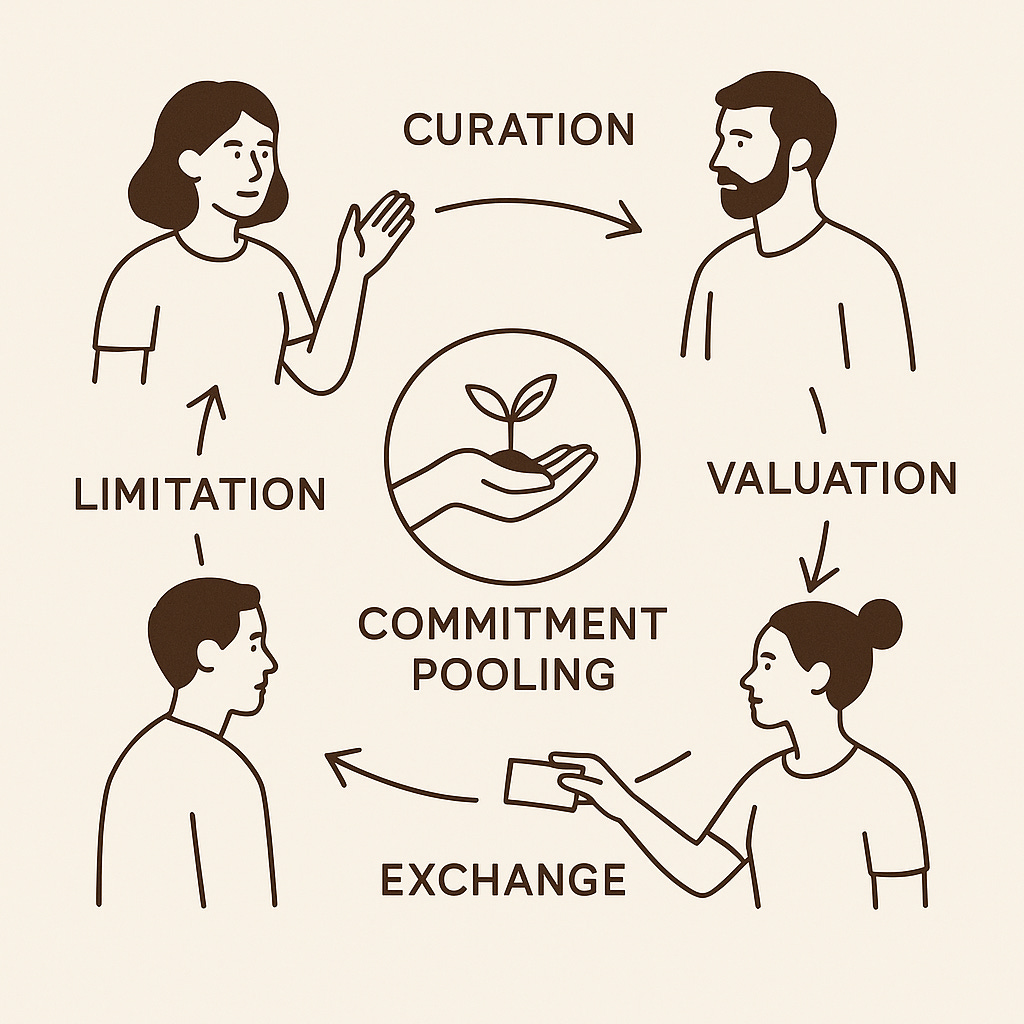
So if you have an idea, a tool, a vision, try expressing it through the protocol of commitment pooling. Use the four fundamental functions of shared coordination:
Curation — What are you offering?
What is the actual commitment you’re making?
Is it time, skills, labor, care, storytelling, teaching, tech, healing, seeds?
Be specific: “I commit to offer 20 hours of soil mapping,” or “I promise to teach three neighbors how to use the local mesh network.”
This is where the promise becomes real—concrete enough that others can recognize and hold it.
Valuation — Why does it matter?
How is your commitment recognized or valued in your community?
Who has seen you do it before?
Is there a history, a reputation, a lineage?
Valuation is about meaning. It answers: “Why should this promise be trusted or how is it valued in this context?”
Limitation — What’s your capacity?
What’s your credit limit - how many promises can you responsibly make before needing to fulfill past ones?
Are you stretched thin? Is your local pool already at capacity?
This protects the integrity of trust in the system.
Naming your limits is an act of care - it keeps the pool healthy and avoids overload.
Exchange — How will this move through the network?
How might your commitment interact with others?
Can someone redeem it? What would fulfilling it look like?
What other commitments could yours be swapped or paired with?
This is the part where your promise enters the living ecology of other people’s care. It’s about routing trust across needs and offers.
If you can express your idea in these terms (what you’re offering, why it’s trusted, what limits you carry, and how others can interact with it) you’re no longer just proposing an idea. You’re planting a vital node in a regenerative network. You’ve given your idea a metabolism - a way to move, respond, and adapt. You’ve invited coordination - real interaction, not just presentation.
…And at the Center: The CommonsWhen you express your commitments through this grammar of care, they don’t just float off into abstraction. They gather. They take root in something shared.
That something is the commons.
The commons isn’t a platform or a product. It’s not a market. It’s a relational center- a field of trust where care is remembered, honored, and coordinated.
It’s the well we all draw from, and the garden we all tend.
It’s where promises live while waiting to be fulfilled.
It’s the pool in “commitment pooling” - not as a liquidity metaphor, but as a collective memory of what we owe and offer one another.So when you translate your idea into a commitment, it doesn’t disappear into bureaucracy - it returns to the center. It becomes part of the shared pattern. And from there, others can see it, hold it, build with it.
The commons is the space between us that remembers us.
And protocol is how we speak to it.So again: speak in promises, not pitches. Speak to the commons, not just to me. Speak to that center where trust lives - and something larger than all of us can begin to take form.
That’s how a regenerative economy begins.
That’s how a protocol becomes a practice.
That’s how care flows.
As you articulate and express yourself and your ideas through commitment pooling, you may find… you don’t need to pitch anymore. You’re already in conversation - with your neighbors, with the commons, with care itself.
And just like Wolfram says of cellular automata: once you learn the language, you’ll start to see differently. You’ll discover that your idea isn’t just a project or a paper. It’s a seed in a much larger mycelial network of mutual aid and memory.
What would your idea look like if it had roots, rhythm, and reciprocity?
Try speaking it in the grammar of care - and see what grows.
That’s when the magic begins.
Thanks, Will, I get many similar requests, I try to be responsive but it does become overwhelming. Many requests are from people who clearly have little knowledge of my work; they don't speak my language. Like you, I want to see some evidence of commitment: Have they done anything more than a cursory scan of my website and the vast body of work and other resources that I've built up over the past more than 2 decades, have they exposed their project to anyone else for comment, are they working with anyone else on it or are they flying solo? I ask them to give me a brief (no more than 500 words) description of their basic ideas, what is unique about their project, and how it might make a difference in anyone's life or the life of their communities.
less recently, perhaps because my scowl is more thoroughly installed, but for years people would hear what I do and say 'I've got an idea for a movie' and I would think, probably not hiding my emotions at all well: 'please don't tell me'...