
Enough
Blood, milk, machines, and the mercy of limits

There are vampires that come in capes, and there are vampires that come with clean hands.
The old stories got the blood right, but maybe not the room. I never saw a vampire in a castle but I saw blood in white rooms, in small bags, under labels written by careful hands. Nurses checked names and numbers. Families sat still. It was not magic or horror. It was help.
I have sat near people I love when they received blood during medical treatment. I have also given blood many times. Giving blood is not great while it is happening. A strap tightens. A needle goes in. The bag fills beside the chair. Sometimes the room tilts a little after, and I eat a biscuit and feel foolish for being weak.
The part I remember now is the limit. They do not let a person give endlessly. They ask questions. They watch the body that gives and the body that receives. The word is simple: enough.
There is mercy in it.
The blood in the bag is not a symbol when it is leaving the arm. It is warmth and salt and ache. It is a body giving a little while others make sure the gift does not become injury.
When I first arrived in Kenya, I saw a man walking down the road with a jug of blood.
The sun was high near Mt Kilimanjaro. The road was red-brown. The jug swung from his hand as if it held milk or water. My body stopped before my mind had decided what to think. When I asked he told me it was blood for drinking, as plainly as if it were tea.
I was new. I did not understand the life I had entered. I had come from places where blood was everywhere but mostly hidden. Meat came wrapped. Milk came sealed. Slaughter and feeding had been given different rooms.
Then there was the jug in the road.
Later I watched the same Maasai bleed his cattle. The cattle were not killed. The blood was mixed with milk. It was food. It was strength. It was part of a rhythm that did not belong to me. The man told me, patiently, that the cattle were used to it and they only took a little.
I saw the blood first. That was my beginning.
Later I saw the hands. I saw the watching. I saw the animal live on. Care did not always look like the pictures I had brought with me. I also knew enough not to make a romance of what I only partly understood.
But the road with the jug taught me something I have not forgotten. What is hidden from me is not always clean. What is visible to me is not always cruel.
There is blood that saves. There is blood that feeds. There is blood taken with care. And there is blood taken because the taker has forgotten how to stop.
That last kind is where the vampire returns.
Not the theatrical fangs or the cape. I mean the figure that stays young while another body weakens. The one who needs the other body and then pretends not to owe it anything. The one who makes taking look elegant.
Everything living eats. Leaving it at that is the trouble. A child in the womb is fed by another body. A newborn may be fed by milk. A sick person may receive blood. A town may live from a river. A data center may live from a grid and a watershed.
The question is not whether receiving can be escaped. The question is how the receiving behaves.
The body that feeds a child is not a field with no owner. It is a person who tires, who hungers. Milk may come with tenderness, pain, pride, exhaustion, and the need for others to help. When a child is growing, someone should also ask who is feeding the mother.
And now the machines have become ever so hungry.
They do not show teeth. They sit in long buildings with locked doors and smooth walls. They answer questions, make pictures, write letters, and predict. To the person holding the screen, they seem light as breath.
But somewhere there is land under them. Somewhere there is water in pipes. Somewhere there is heat going out. Somewhere there was a mine, a worker on a night shift, a town asked for permission, a river asked to serve.
The machine may not drink blood, but it eats water and power and metal and attention. It eats old words and new words. It eats from places that may never be named when the profit is counted.
If it gives back, then name what came back. Name whether the town grew stronger or only busier. Name whether the workers could speak, whether the people near the building could say no, whether the river was listened to before it was asked to serve.
The danger is not hunger. The danger is hunger that becomes too polished to hear an answer.
In villages I have known, people remember things that no machine can hold well: who came when the roof needed lifting, who gave seed, who brought maize late and came back with an apology, who was sick, who should be asked gently. An elder once told me, in his own way, that people remember what keeps them alive.
In a small place, memory can live in faces. In a large place, memory leaks out. The buyer does not know the farmer. The machine house knows the river as a number. The screen does not know the mine.
So some things must be carried. No book, office, machine, meeting, or law can hold the whole world. But enough must be remembered that taking can stop when harm begins.
Who was asked? What was the limit? Who watched afterward? What was returned?
I think again of giving blood. The bag does not fill forever. Someone made a rule before I arrived. Someone decided the body gives this much and no more. Someone watches afterward. Someone says to sit a while.
Thank goodness for the wisdom there.
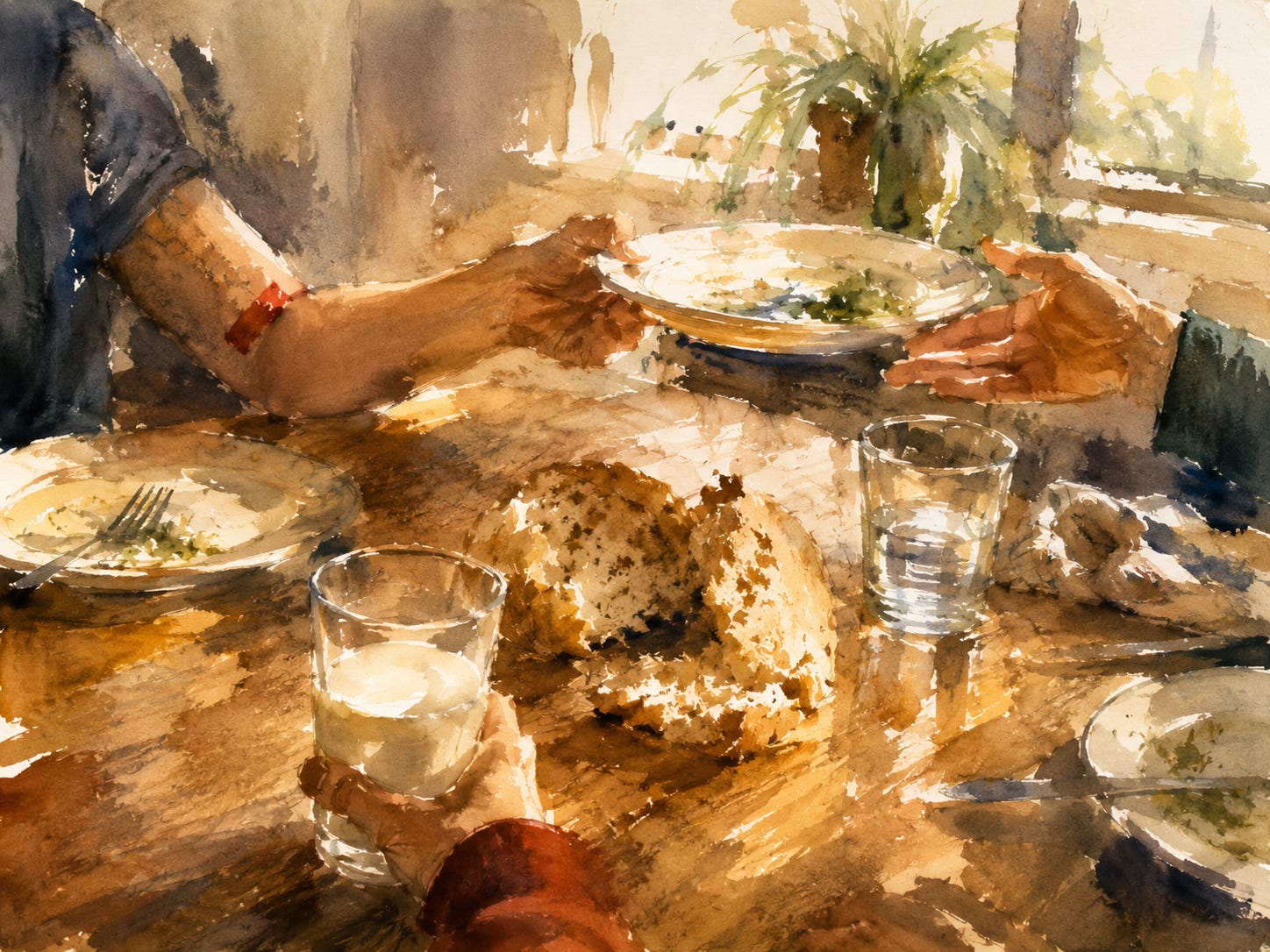
At a table, the wisdom can begin again. Bread, milk, water, light, hands passing plates, someone laughing, someone tired, someone washing up. Nothing pure or sterile. Nothing untouched. Only a meal that can still remember it was fed by bodies, places, and work.
That is the hopeful thing I can hold. Appetite does not have to become entitlement. A table can teach limits. A gift can include recovery. A town can ask what it owes the river. People can eat and still remember to return something.
Maybe common sense for those who eat begins there.
All fits together, or it all falls apart. But it's not really a mystery, the gift must move, as so well said by Lewis Hyde, and many others.
Tom Greco was always particularly clear on this, opened the space.
Thank you for your wise writing and practice of Grassroots Economics, Will! I'm sorry we didn't get to meet in person before we departed Kenya for Chile in 2022.