
Composability of Intentions
A tiny protocol for coordinated action

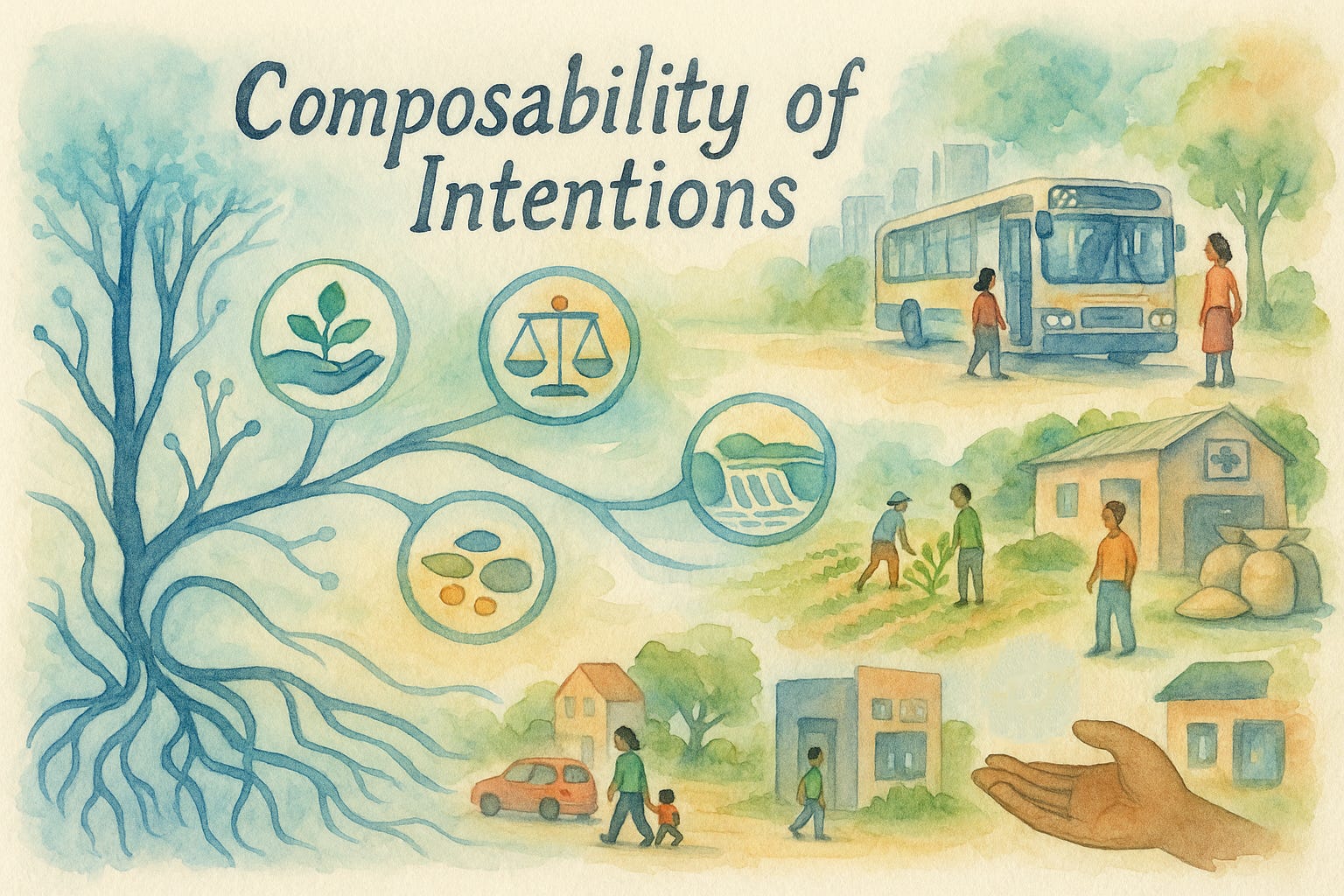
Imagine for a moment economics as sorting. Picture living systems spending their days deciding what goes where, when, and how much. A forest does this without a meeting. Mycorrhizal fungi run quiet routes between roots, shuttling sugars and minerals to where they’re needed, throttling flows when storms or pests arrive, and opening new paths when a sapling takes hold. No one is in charge; the network “just works” because each exchange obeys simple local rules that make the whole more alive.
“A complex system that works is invariably found to have evolved from a simple system that worked.” - John Gall (Gall’s Law)
We are part of social organisms (societies, families, groups, Kayas, villages, organizations) solving the same sorting problem. Each of us can voice an intention, make a promise, and (when it is precise enough to be held) enter a formal commitment. “I will deliver this, for that party, by then.” Once witnessed, a commitment becomes part of our shared memory. The question is how to let billions of such commitments compose into reliable coordination.
We already do this in our feelings before we do it on paper. Families and groups often form an ecology of the heart that runs on emotional pooling: you notice who has shown up, who is stretched, who can take one more task. Credit (reputation) increases for those who fulfill their promises; limits tighten for those who vanish. It is still sorting, guided by trust and relational memory. But emotional memory alone frays under scale and stress. We need a clear, lightweight way to say and make transparent the same things we feel: what we accept, what it’s worth today, how much is safe to draw, and how reciprocity is expected.
Commitment pooling draws from these systems as a minimal protocol for coordination that can be written down. It creates stewarded space where commitments can be chosen, where a value index tells us today’s rate of trade, where limits prevent drain or overload, and where settlement is clear. Plainly commitment pooling is described by four simple functions: curation decides which commitments qualify, valuation sets the exchange rate, limitation shapes how much can flow and how fast, and exchange performs the swap and records the outcome. Different agents stewarding different pools can implement these functions with different values and limits, but they speak the same grammar. That shared grammar is what makes composability possible.
Composability here means that commitments from many actors and held in many pools can click together without special deals or centralization. When two pools recognize the same kind of commitment (like a formal voucher) a swap can route across them. Each hop checks the same four things, so safety is local yet preserved hop-by-hop. The effect is like the forest: a polycentric mesh where resources find their place through small, rule-consistent moves. This is what we mean by cosmo-local.
Once internalized and spoken as language - our vocabulary starts to shift from earning, incomes, transactions, paychecks and employers. You issue representations of your promises like vouchers when you make a commitment others can hold. When you later deliver, you are redeeming the vouchers you already put into the world. Fulfillment removes your voucher from the pool, which lowers your outstanding obligations and raises your credit where that voucher was listed.
Your path to more access is the simple act of closing what you opened.
Because the rules are few, the feel is natural - something you already do. In a neighborhood, parents list school-run slots and a neighbor lists weekend repair time. The pool accepts those commitments, posts today’s going rate between them, caps how many runs or fixes one person can carry, and pays out the moment proof of completion arrives. A Tuesday ride is delivered to a family, the driver’s voucher is swapped out of the pool and returned to the driver - the driver’s credit nudges up, and the family’s debt (as their voucher committing to repair - in the pool) is swapped out by another neighbor to fix her roof. No drama, no mystery, no Ancient Roman Traditions - only protocol and memory made public.
Scale that same logic as a language and nothing breaks. A grain pool lists maize-by-grade; a finance pool lists short credit. A farmer routes grain→credit through the shared unit; each pool enforces its limits, and when a miller redeems grain, the farmer’s outstanding voucher falls and access returns.
These systems show how much coordination can emerge without central command - what we need is a small, shared protocol for composable commitments.
Public memory, holds this together. Pools don’t need flowery contracts or complex curves to be fair; they need clear commitments, a posted index, sane caps, and prompt closure. When heat waves arrive, a transit pool can lift the value of late shifts and tighten overtime while a clinic pool publishes ride windows; the two compose through shared shops credits because they, too, can redeem them for listed services or convert them on schedule. When drought pinches, two village pools agree temporary bridges on water and labor commitments, then unlink when the season turns.
The elegance lives in the interfaces. Curation keeps the language clean so only real, redeemable commitments enter. Valuation keeps exchange legible today, not guessed tomorrow. Limitation keeps people and reserves from burning out. Exchange closes the loops and leaves an immutable record in the shared memory. When every pool runs these same minimal functions, routing becomes ordinary: if there is value and inventory and the caps allow it, the swap goes; if not, it waits or finds another path. The network stays honest because fulfillment and memory keep meeting.
This is what “economics as sorting” looks like when we remember that value is a relationship. The protocol does not impose a grand hierarchy; it gives small nodes enough shared structure to act together. A household, a co-op, a city bureau, a farmers’ union - each can issue and redeem its own vouchers, accept those it trusts, and set its own index and limits.
Because the grammar is common, the pieces compose. Because fulfillment is visible, trust accumulates. Because limits are explicit, stress is managed before it becomes crisis.
Fungi solved coordination with basic protocols and shared pathways. Communities do it with feelings first, and then with ledgers when scale demands clarity. Commitment pooling as a protocol turns commitments into flows that can join and part without friction.
“Simplicity is prerequisite for reliability.” - Edsger W. Dijkstra
Simple is not simplistic; it is the shortest honest path from “I will” to “We did,” across a network that is strong because its parts can connect and let go on time.
Love this
This composability framework is powerful for production coordination: visible commitments create a 'resource map' where people identify production opportunities and issue conditional output commitments backed by available inputs. Pools finances production by enabling commitment swaps, either direct exchanges with input holders or indirect exchanges through other commitments.
ValueFlows vocabulary provides a formal model: Intents/Commitments as the resource map, ProcessSpecifications as production recipes, and Processes with linked input/output Commitments as conditional production. ValueFlows handles timing risk through Intent → Commitment progression and inventory-aware planning.
Has anyone explored integrating ValueFlows' Process/Recipe layer with commitment pooling?