
Camembert d’Attention
My little wedge of cheese

Lately I have been thinking about the limits of my own attention.
How many people can I truly care for? How many relationships can I maintain with integrity? How many collaborations can I nurture without becoming stretched thin? How many commitments can I steward well?
When I look honestly at my life, I encounter a boundary a bit like a semi-strethy membrane. Not a failure or weakness. Simply part of being myself.
I cannot give equal time, energy, understanding, and care to everyone.
Herbert Simon framed attention as a scarce resource. In an information-rich world, he wrote, “a wealth of information creates a poverty of attention.” That helps me name what I feel often: the limit is not only how much information I can receive, but how much care, response, and meaning I can give. (L’Atelier des Futurs)
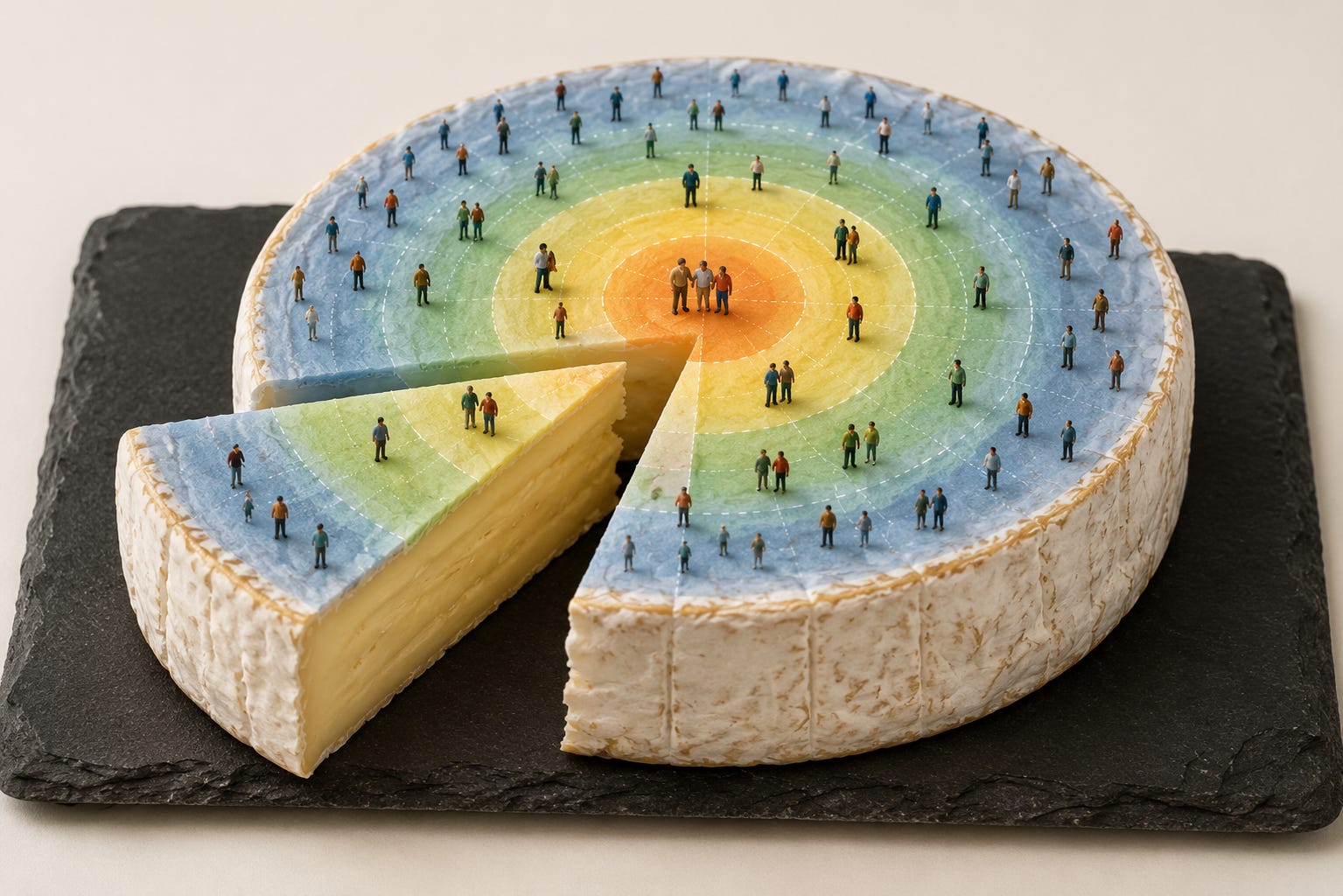
To think about this, I imagine a round of Camembert cheese. (easy to imagine at the moment!!)
The whole wheel of cheese represents the social world around me. Family, friends, colleagues, partners, communities, organizations, ecosystems, and strangers whose lives intersect with mine.
I am not the whole wheel. I occupy only a little wedge. My little wedge is the portion of the world I can (do/will/want to) actually attend to. And within that small wedge, attention is not evenly distributed.
At the narrow point, near the center of the wheel (le cœur du camembert), are the few people who receive the deepest investment of my time, energy and love. Further out, the wedge grows wider. There is room for more people. But each person receives a smaller share of my attention.
The shape tells a story. Near the center, there is little space, but great depth. Further outward, there is more space, but less intensity.
The wedge becomes something like an attention cheese pyramid. At its heart is family. Then close friends. Then deep collaborators. Then trusted partners. Then community members. Then acquaintances.
Then people I may never meet, but whose wellbeing still matters to me.
There are two kinds of overlap in this image.
The first is overlap inside my own little wedge.
My family, friends, collaborators, and work partners do not form perfectly separate rings. A family member may also be someone I think deeply with. A close friend may also become a collaborator. A colleague may move inward through years of trust, or outward when shared work ends. The layers help me see patterns, but they are not walls.
Recent work on social relationship structure argues for moving “beyond Dunbar circles” toward a more continuous model of social relationships and resource allocation. That is helpful here because my wedge is not a stack of fixed boxes. It is more like a gradient of time, care, memory, obligation, and availability. (Nature)
The second is overlap between wedges.
Everyone I am connected to also occupies their own wedge. Each person has their own slice of the wheel. Where my wedge overlaps with another person’s wedge, a relationship emerges.
Where many wedges overlap, a community may emerge. Where communities overlap, an organization or network of organizations may emerge.
The entire wheel is not owned by anyone. It is created through the overlapping attention of many people. This gives me one image for how my social world is formed: not as a single center, but as a pattern of overlapping wedges of care. (Very cheesy).
Social network research has long treated overlap as important. Granovetter argued that “the degree of overlap” between two people’s friendship networks varies with the strength of their tie. In other words, stronger relationships often come with more shared context, more shared people, and more shared social worlds. (Chicago Journals)
Network science also studies “overlapping communities.” Palla and colleagues found significant overlaps in complex networks in nature and society, while later ego-network research explicitly models “nested as well as overlapping” social circles around a person. That gives language for both parts of the Camembert image: nested layers within my own wedge, and overlapping wedges across people. (PubMed)
The Science of Attention
Modern social science gives me useful language for something I notice in my own life.
The most famous work comes from anthropologist Robin Dunbar, who proposed that human social relationships tend to organize into nested circles.
The numbers are often approximated as:
5 intimate relationships
15 close relationships
50 meaningful relationships
150 active social relationships
Some versions of this model extend outward to wider layers of roughly 500 and 1500, but I hold all of these as approximations rather than fixed limits. (Royal Society Publishing)
Beyond these layers, relationships become increasingly difficult to maintain for me.
For many years I have heard of these numbers being treated almost as natural laws. More recent research, thankfully, suggests reality is more nuanced. The exact numbers vary dramatically between individuals. Some people maintain larger networks. Others maintain smaller ones.
What appears more useful to me is not the exact number itself, but the pattern. Human attention (like the waking hours of a day) is finite. Relationships require maintenance. Trust often requires reinforcement. Shared understanding requires repeated interaction.
As the number of relationships increase, my attention becomes divided. The result is a layered structure. To be conscious of this is key for me … because I live within limits of time, memory, emotional capacity, and embodied life.
Lindenfors and colleagues directly criticize the idea that one fixed “Dunbar’s number” can be derived with statistical confidence. Their critique does not make the layered metaphor useless. It simply warns me not to treat 150, or any other number, as a rigid human law. (PMC)
A 2025 study on individual differences in perceived energy allocation found that people vary in how they distribute energy across social layers. This supports using the Camembert wedge personally and diagnostically, not as a universal measurement tool. (PMC)
Importantly, not all my relationships consume equal amounts of attention. A deep friendship requires more maintenance than a casual acquaintance. My family relationship sit at the heart of my wedge because they carry long memory, obligation, daily life, and love.
Some relationships also move inward because they require shared strategy, repeated repair, and deep context.
And some relationships are uniquely demanding.
Let’s talk about Deep collaboration.
The Scarcity of Deep Collaboration
There are people with whom I can have a pleasant conversation. There are people with whom I can work. And then there are people with whom I can think.
The last category is much … much smaller, and that is ok.
These are the people with whom I can spend hours discussing ideas, reviewing documents, designing systems, resolving tensions, and imagining futures.
People with whom shared context accumulates over years. People who understand not only what I am doing, but why.
In my own life, I notice that this deep collaboration layer can compete for the same scarce attention as close friendship and family, even when the emotional texture is different. It asks for memory. It asks for responsiveness. It asks for trust. It asks for repair. It asks for time.
Roberts and Dunbar’s work on relationship decay found that friendship quality declined across a major life transition, but that decline could be mitigated by increased relationship effort. This matters because attention is not only a feeling. It is also maintenance. (PubMed)
Research on teams gives me another lens. Deep collaboration is not just having many good people in the room with me. It depends on shared context, shared memory, role clarity, and knowing who knows what.
Wegner’s concept of transactive memory describes group memory as individual memory systems joined with the communication between people. For deep collaboration, this is crucial. A small group can think together partly because members know each other’s knowledge, judgment, and blind spots. (Harvard DTG)
I have been impressed by a related body of work on team size that suggests caution around assuming that bigger is automatically better. Smaller teams can be more able to generate disruptive new ideas, while larger teams often become better at developing and extending existing work.
A large-scale Nature study of more than 65 million papers, patents, and software products found that smaller teams tended to disrupt science and technology, while larger teams tended to develop existing ideas. (Nature)
This does not mean small is always better. It means different sizes do different things.
This suggests another layer hidden inside the attention pyramid. The deep collaboration circle. Perhaps three to eight people .. as a working estimate for the number of people with whom I can sustain high-context, frequent, mutually shaping collaboration.
Not necessarily my closest friends. Not necessarily family. But people with whom I build an grow. People with whom I share responsibility for creating something larger than ourselves. These relationships occupy a unique place within my wedge of cheese.
They consume a lot of attention. But they also multiply capacity. Through them, my one little wedge becomes connected to many others.
Organizations as Wedges
I think organizations face a parallel constraint. An organization does not possess infinite attention any more than a Aperson does. Organizations also have centers and edges.
Core teams. Active contributors. Trusted partners. Broader networks. Peripheral participants. Every organization develops something like its own attention cheese pyramid.
At the center are a handful of people carrying the deepest context.
Further out are teams and collaborators. Further out still are stakeholders, supporters, partners, and communities.
As organizations grow, the challenge is not simply adding more people. The challenge is maintaining coherence. Maintaining enough overlap between wedges that people can continue acting together.
This may be one of the central problems of organizational life. Not only growth. Not only scale. ….. Attention.
Ocasio’s attention-based view of the firm argues that firm behavior depends on how organizations channel and distribute the attention of decision-makers. That gives organizational language to the same question I am asking personally: what receives attention, through which relationships, and under what rules? (JSTOR)
For organizations, partnerships also have attention costs.
A larger network of partners can bring knowledge, legitimacy, funding, and resilience.
But every partnership also requires communication, alignment, expectation-setting, repair, and memory.
Alliance portfolio research treats partnerships as portfolios that must be configured and managed, not just accumulated. Some studies find inverted U-shaped effects, where more partnerships or more diversity help up to a point, and then coordination costs, complexity, or bounded attention begin to reduce performance. (EM Lyon Research)
This matters because the outer layers of an organization’s Camembert wedge are not meaningless….. Weak ties can be powerful.
Granovetter’s classic work on weak ties showed how less intense relationships can connect otherwise separate social circles, carrying information and opportunities that may not circulate inside close-knit groups. (JSTOR)
So the question is not whether inner layers are “better” than outer layers.
It is what kind of attention each layer can honestly receive.
The inner layers carry depth. The outer layers carry reach. The middle layers often carry translation.
Grassroots Economics as a Wheel of Overlapping Wedges
When I think about Grassroots Economics Foundation, I see another wheel of Camembert.
At its center are a small number of directors and core team carrying years of shared memory. People stewarding relationships, technologies, stories, commitments, and responsibilities.
Around them are active builders. Developers. Researchers. Community coordinators. Ecosystem stewards. Pool stewards. Practitioners.
Further outward are trusted partners. Organizations and communities with long histories of collaboration.
Beyond them are participants across regions, countries, and ecosystems.
The foundation exists because these wedges overlap.
No individual sees the whole wheel with equal resolution. I certainly do not. Each person holds only a portion. The organization emerges from the stitching together of these partial perspectives.
Grassroots Economics’ own materials already use the language of overlapping pools. One section describes families participating in many Mweria-like groups, with commitments and reputation moving across neighbors, clans, childcare, farming, construction, emotional support, weddings, and funerals. It also says that “a single pool isn’t enough” for commitments to move across clans without centralization problems.
This understanding changes how I think about leadership. Leadership is not seeing everything. Leadership is helping wedges overlap. Leadership is creating enough shared context for coordination to occur. Leadership is stewarding attention.
Network governance research helps make this more precise. Provan and Kenis argue that the effectiveness of organizational networks depends partly on governance form, trust, number of participants, goal consensus, and the need for network-level competencies. For me, this means Grassroots Economics cannot rely only on goodwill. It also needs structures that match the size, trust, and complexity of the network. (Tilburg University Research Portal)
Grassroots Economics also has a second kind of attention challenge. It is not only a single organization with an internal wedge. It is also part of a network of networks.
Each community, steward, partner, funder, developer, and researcher has their own wedge. Grassroots Economics becomes visible where these wedges overlap around shared commitments.
The round of cheese is therefore not just “Grassroots Economics.” It is the living pattern formed by many people’s attention, across many places, with different depths of relationship and responsibility.
Commitment Pools as Attention Pools
The same pattern appears within Commitment Pools (or can be derived form the protocol). At first glance, Commitment Pools are about commitments, curation, valuation, limitation, and exchange. In the kinds of Commitment Pools I care about, curration depend not only on ledger entries, but on attention.
Attention to promises. Attention to fulfillment. Attention to relationships. Attention to trust. Attention to limits.
A steward cannot curate an unlimited number of commitments with equal depth. A steward cannot deeply monitor an unlimited number of pools. A community cannot maintain high-trust accountability across an unlimited number of relationships.
Limits are not merely technical. They are also part of being people.
The Cosmo-Local Credit materials defines Commitment Pools as systems coordinating redeemable commitments through four pooling functions: curation, valuation, limitation, and exchange. It also specifies the steward role: deciding listings, values, fees, limits, guarantees, and pauses. That makes stewardship a form of structured attention, because the steward must decide what enters, how it is valued, how flow is limited, and how exchange settles.
The same nested structure appears again. A steward may deeply understand a handful of pools. Actively monitor more through regular contact, reports, or trusted coordinators. Recognize many more through public registries, shared standards, and reputation. Route across still more through software, other stewards, and explicit limits. But the depth of attention changes at each layer.
In the systems I want to help steward, I would rather make these limits visible than pretend they are not there. The purpose of governance for me is not to eliminate limits. The purpose of governance is to work honestly within what we know of them.
Grassroots Economics describes stewards as guiding the four core functions of a pool (curation, valuation, limitation, and exchange), seeding resources, fostering trust, and bridging local traditions with modern tools. This supports the idea that stewardship is not only technical administration. It is a relational role.
In this sense, Commitment Pools can be understood as structured expressions of collective attention.
They help communities ask:
What are we willing to recognize?
What are we willing to value?
What must we limit?
What can safely flow?
What deserves our care?
What deserves our trust?
What deserves our capacity?
And how much attention can we realistically provide?
Grassroots Economics’ materials describe overlapping pools as connecting resources, commitments, and relationships across bioregional, emotional, cultural, project-based, skill, and knowledge spaces. They also describe each steward curating offerings while overlap emerges between smaller circles. This is very close to the Camembert image: many bounded wedges, many overlaps, no need for one totalizing center.
Grassroots Economics similarly frames a polycentric network of commitment pools where each pool is “a center of care and coordination,” connected through shared values, fulfilled commitments, and reciprocity. It also names mapping as making visible what already exists, not inventing or imposing.
Gratitude for My Small Wedge
The older I become, the less interested I am in becoming the whole wheel.
Abundance, for me, is not infinite individual attention, but what becomes possible when our limited wedges overlap and our pooled attention can care, notice, remember, and build more than any one of us could alone.
I do not need to hold everything. I do not need to know everyone. I do not need to steward every commitment. What matters is the quality of my own wedge.
Its depth. Its integrity. Its overlaps with others. Its contribution to the larger whole.
I am grateful for my family at the center. For friends who have remained through many seasons. For collaborators who help me think. For partners who help me build. For communities that trust me with their stories and commitments. For those whose wedges overlap mine, however briefly. And for all the countless wedges I will never fully see.
The wheel I can sense is larger than what I can personally hold.
That humbles me. It also relieves me. My task is not to become the whole Camembert (phew!). My task is to notice the small wedge entrusted to me.
To care for the heart of it. To respect its limits. To repair its torn edges where I can. To honor the people whose attention overlaps with mine.
And to steward my little wedge of cheese with as much care, humility, love, gratitude, and attention as I can.

you raise a point I speak about often to people - relationships matter - AND - how we ho0ld those relationships are essential. Our capacity to give time and attention, to truly water and nourish them, becomes less and less the MORE we take on - and what is enough? what is our capacity? what is too much? ... each of these such individual answers but rarely looked at in a way that allows us to realise the interplay .. that whilst being part of the whole we arent called to carry the whole